It's a common pattern. Newly elected government are fresh and vigorous and brimming with ideas and energy. They can't wait to get to work and can't wait to do good. Reform is in the air; time is their enemy.
Then some time passes and middle age sets in and the tone changes. They've earned some experience and so they become a little more cautious and a little more careful as the bloom of youth fades.
That evolves into the aged government - defensive and maybe a little paranoid. Ideas are hard to come by and there's a world-weary "we've seen it all before" feeling that sets in. Getting up in the morning is hard, doing a full day's work is a chore and there's bloating around the midriff. More holidays are taken. Enthusiasm is down and coasting on past glories is preferred. Complacency and entitlement take over.
We've seen the pattern before. Smallwood went through it all by himself. Then the PCs came to power. Through Moores, Peckford and then Rideout, they rode through all three stages. When the Liberals won in 1989, Wells, Tobin and Grimes passed through the stages without even noticing.
These are the early days of the new mandate for a still relatively young government. They have just won, by their own estimation, a thunderous mandate. And it is a very impressive mandate.
Yet the ominous signs of government old age are there. After only four years.
Consider this: Williams has taken 3 weeks to appoint a cabinet which is largely a team of steady-as-she-goes; pretty well all the major portfolios (Finance, Fisheries, Health, Education, Natural Resources, Human Resources) have the same old bodies in them.
And let's be realistic about this: it wasn't as if there were agonising choices to be made unless the Premier was awake nights truly torn between monumental choices between the likes of Dave Denine and Steve Kent for municipal affairs.
And Williams didn't take 3 weeks because he was planing for the best people to undertake reforms. In the case of Fisheries, the reappointment of Tom Rideout only ensures a stubborn refusal to take anything remotely resembling initiative during a time of drastic change in the industry. Unless maybe that's the plan all along.
 As for cabinet size, it has swollen to 18 ministers, up 29 per cent from the 14 ministers sworn in when Williams first took office in 2003. That's a pretty big cabinet and it's as large as the previous cabinets which Williams rightly excoriated for being huge and bloated.
That's not including the 5 parliamentary secretaries who do not sit in Cabinet, who do not answer questions in the house, who are not responsible for any decisions, who do not manage any part of any department but who still pick up an additional salary stipend of roughly $35K.
In fact, it's worthwhile noting that while the perks and the ability of a parliamentary assistant to reimburse for expenses are carefully laid out in the recent House administration documents, their duties, in this case the Premier's assistant although the others are similar, are vaguely defined with no clearly delineated responsibilities:
William's defence of his cabinet size was that:
Those hoping to become cabinet minister win both ways. In the end, the trend is to ever growing cabinets.
One would think that such a large group of enthused servants of the public would be chomping at the bit to get to work. But no. Instead, Williams has decided to put off the House until the spring of the year.
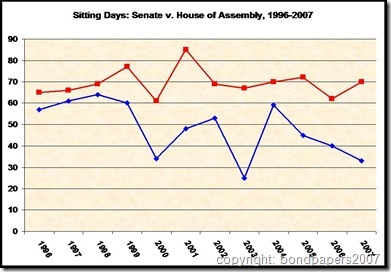 Even Tom Rideout, government's defender-in-chief on the issue of House opening delay, once promised a budget and throne speech within two weeks of his winning the leadership. Meanwhile, even the City of St. John's will have met for more days in 2007 than the House of Assembly. So will have the useless and do-nothing Senate of Canada
Williams justifies this action by saying:
If this year's new lows in House activity was exceptional then there would be not too much more to be said about it. But that's not the case. Instead, since this government was elected, it's House activity has steadily diminished to the current low levels.
It all adds up to a government in the throes of political progeria; a disease of premature aging where the effects of old age settle prematurely to strike at efficacy and energy. The signs of diminished capacity, reduced energy and efficacy appear far earlier than normal.
Williams presides over a government where the inevitable signs old age, which usually become apparent after a decade or more and several different leaders has, in this case manifested themselves at the end of a single term: bloated cabinets of familiar faces defending old polices combined with a reluctance to open the House and then, when the House is open, a reluctance to keep it open.
 What do we have to look forward to? I suspect more defensiveness (as if that were possible), more crowing over past glories like the Atlantic Accord $2billion instead of announcing new initiatives, endless rehashing of old initiatives, creative hyping of minor tinkers to existing programs and generally a whole lot less energy and ideas.
Definitely no hope for reforms on any level. It's just steady as she goes.
Break out the wheelchairs.
Then some time passes and middle age sets in and the tone changes. They've earned some experience and so they become a little more cautious and a little more careful as the bloom of youth fades.
That evolves into the aged government - defensive and maybe a little paranoid. Ideas are hard to come by and there's a world-weary "we've seen it all before" feeling that sets in. Getting up in the morning is hard, doing a full day's work is a chore and there's bloating around the midriff. More holidays are taken. Enthusiasm is down and coasting on past glories is preferred. Complacency and entitlement take over.
We've seen the pattern before. Smallwood went through it all by himself. Then the PCs came to power. Through Moores, Peckford and then Rideout, they rode through all three stages. When the Liberals won in 1989, Wells, Tobin and Grimes passed through the stages without even noticing.
These are the early days of the new mandate for a still relatively young government. They have just won, by their own estimation, a thunderous mandate. And it is a very impressive mandate.
Yet the ominous signs of government old age are there. After only four years.
Consider this: Williams has taken 3 weeks to appoint a cabinet which is largely a team of steady-as-she-goes; pretty well all the major portfolios (Finance, Fisheries, Health, Education, Natural Resources, Human Resources) have the same old bodies in them.
And let's be realistic about this: it wasn't as if there were agonising choices to be made unless the Premier was awake nights truly torn between monumental choices between the likes of Dave Denine and Steve Kent for municipal affairs.
And Williams didn't take 3 weeks because he was planing for the best people to undertake reforms. In the case of Fisheries, the reappointment of Tom Rideout only ensures a stubborn refusal to take anything remotely resembling initiative during a time of drastic change in the industry. Unless maybe that's the plan all along.
As for cabinet size, it has swollen to 18 ministers, up 29 per cent from the 14 ministers sworn in when Williams first took office in 2003. That's a pretty big cabinet and it's as large as the previous cabinets which Williams rightly excoriated for being huge and bloated.That's not including the 5 parliamentary secretaries who do not sit in Cabinet, who do not answer questions in the house, who are not responsible for any decisions, who do not manage any part of any department but who still pick up an additional salary stipend of roughly $35K.
In fact, it's worthwhile noting that while the perks and the ability of a parliamentary assistant to reimburse for expenses are carefully laid out in the recent House administration documents, their duties, in this case the Premier's assistant although the others are similar, are vaguely defined with no clearly delineated responsibilities:
Parliamentary Assistant to the Premier shall assist the Premier in the manner that the Premier directs.In practice that means taking the meetings, passing on bad news to groups/individuals and generally doing the grunt work that the minister can't be bothered with. Here's a hint: if you have a meeting with the Parliamentary Assistant to a minister, you are being given an elaborately polite brush-off.
William's defence of his cabinet size was that:
“Right now the province is on a growth track, (there’s) a very positive feeling in the province that we’re going to drive the province forward, and I think we need to make sure that we’ve got ample resources so that the job can be done completely.”Previous government have defended increased cabinet sizes in all kinds of ways. I'm sure more than a few have argued the province was going through difficult times so we needed a larger cabinet to cope. And now that we are going through good times, we need a larger cabinet to cope now too.
Those hoping to become cabinet minister win both ways. In the end, the trend is to ever growing cabinets.
One would think that such a large group of enthused servants of the public would be chomping at the bit to get to work. But no. Instead, Williams has decided to put off the House until the spring of the year.
Even Tom Rideout, government's defender-in-chief on the issue of House opening delay, once promised a budget and throne speech within two weeks of his winning the leadership. Meanwhile, even the City of St. John's will have met for more days in 2007 than the House of Assembly. So will have the useless and do-nothing Senate of CanadaWilliams justifies this action by saying:
“So to turn around this fall and prepare another throne speech when we really haven’t concluded half of what we set out to do in the year, I just think would be inappropriate, it would be unproductive, it would be just a repeat, a complete re-spin of what we said before.”Really? I wonder what the election was all about then? Was the Blue Book mere window dressing? I suppose we can all look forward to a Spring legislative agenda that is new and exceptional and wholly unlike whatever this government has been doing the last four year. I know I'll be holding my breath for that.
If this year's new lows in House activity was exceptional then there would be not too much more to be said about it. But that's not the case. Instead, since this government was elected, it's House activity has steadily diminished to the current low levels.
It all adds up to a government in the throes of political progeria; a disease of premature aging where the effects of old age settle prematurely to strike at efficacy and energy. The signs of diminished capacity, reduced energy and efficacy appear far earlier than normal.
Williams presides over a government where the inevitable signs old age, which usually become apparent after a decade or more and several different leaders has, in this case manifested themselves at the end of a single term: bloated cabinets of familiar faces defending old polices combined with a reluctance to open the House and then, when the House is open, a reluctance to keep it open.
What do we have to look forward to? I suspect more defensiveness (as if that were possible), more crowing over past glories like the Atlantic Accord $2billion instead of announcing new initiatives, endless rehashing of old initiatives, creative hyping of minor tinkers to existing programs and generally a whole lot less energy and ideas.Definitely no hope for reforms on any level. It's just steady as she goes.
Break out the wheelchairs.