Wednesday, October 29, 2008

More money than you can imagine

For an election campaign, anyways. Tonight will see the airing of Barak Obama's 30 minute infomercial - an extended campaign ad with both taped and live components. Some of the taped components were filmed by Davis Guggenheim, whose father was the campaign documentarian of Robert F. Kennedy. Considering that Obama's speeches are scripted by a man who worked closely with Ted Sorenson, JFK's speechwriter, it seems that Obama has a fondness for that particular school of Kennedy associated talent.

According to the NY Times, this ad will be shown on NBC, CBS, Fox, Univision, MSNBC and two cable networks that cater to African-Americans, BET and TV One. Ross Perot is that last presidential candidate to run 30 minute ads; eight long infomercials to an average of 13 million viewers, with one of them getting 16.5 million viewers.

This media shot will cost $3million although some reports peg the price tag at more like $6million. Just to put it into perspective, the entire national Conservative Party campaign in the past federal election came in at around $22million for everything. In the last provincial election, all the political party spending put together didn't come close to $3million (I suspect it was more like half of that, numbers have yet to be released).

And this is just the tip of the iceberg. In October, the Obama campaign spent more than $100million and is currently running about 7700 commercials a day. McCain, because he accepted public funding, is limited to a campaign spending ceiling of $84million for everything - he's only running less than half the number of ads and can't afford anything longer than 30 seconds. A detailed breakdown of who spent how much on what ads can be found here.

McCain has had to make choices in where he spends money and he's chosen to play defence. While Obama can spend big money everywhere, McCain, has had to reduce his advertising in swing states like New Hampshire and Wisconsin so he can advertise in states he must win, like Florida, Ohio, Pennsylvania and Virginia.

If you are living in places like Washington DC, Virginia or Florida, you will find that almost every prime time show, daytime show and news program is saturated with political advertising. Mostly Obama's.

If money is the mother's milk of politics then Obama must be close to drowning.
Tuesday, October 28, 2008

Shepard Fairey

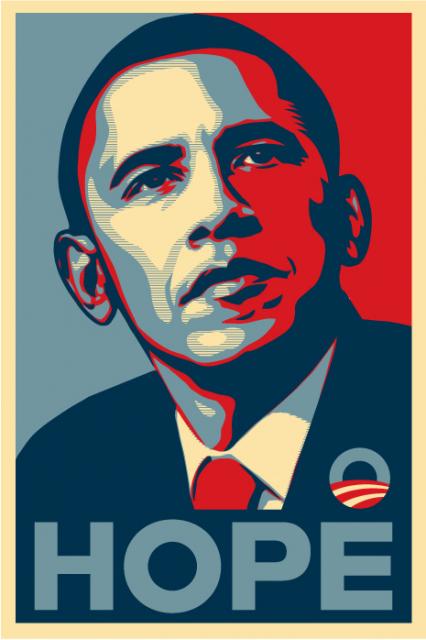
If you are following the Obama campaign (and what Offal reader could resist), then you will run across the Shepard Fairey Obama poster. He originally developed two: Hope and Progress. A first print run of 350 was sold out within minutes for $45 a piece. They started to pop up on eBay for as much as $10,000 in no time. What started as a poster of a politician had quickly become an pop culture icon.


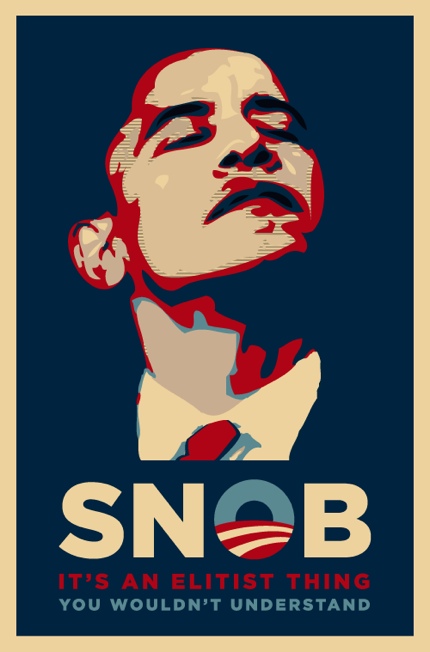
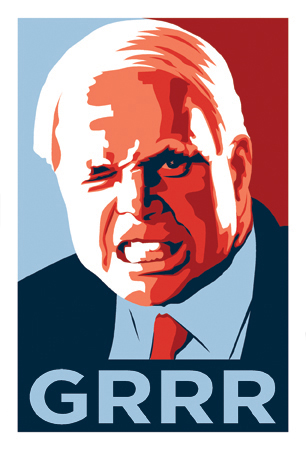
And what becomes iconic quickly becomes a target for parody. Here are some of my favourites:


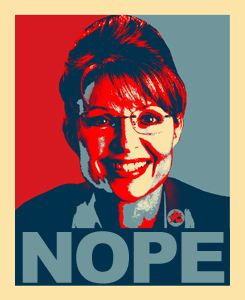
You can count on the other side not getting off easily.


There is a fine collection of other Obama poster parodies here.

Iceland hikes rates to 18%

According to this report from BBC NEWS, Iceland's interest rate up to 18% from 12% as they struggle to stabilize their currency. The IMF has already loaned them $2billion and the Icelandic central bank figures they need another $4billion to do the job.

Meanwhile, the Icelandic crown traded internationally for the first time for a week on Tuesday, with the value slumping to 240 to the euro from Monday's official fix of 152.

They have a deep hole to climb out of before they see daylight again.

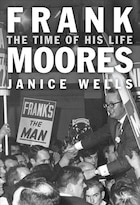
My own Christmas book list - Frank Moores

Inspired by the Bond Papers Christmas book wish list, I offer my own choices. . . .

One of my earliest political memories was the provincial election of 1972 when Frank Moores defeated Joey Smallwood. The local newspaper printed a score card of all the candidates so you could track the results at home as they came in on the radio. I remember sitting at the kitchen table, keeping track of the results on the scorecard until I was shooed off to bed. By the next morning, the political world of this province had undergone a seismic shift. Smallwood was gone and Moores was in.
I never knew Moores although I met him once. I do know people who knew him very well. I know a lady in Manitoba who met Frank when she was young. Her father was a federal Tory politician and Frank would drop in from time to time for a drink and a chat. She recalls that he seemed to keep company with a variety of attractive female companions.

He seem to have inspired a fierce staff loyalty. My old next door neighbour was his private secretary (I believe that was her job, she didn't talk about it too much) except for a fierce glare at anyone who might utter any disparaging word about her former boss, even years later.

Like many other people, I heard stories about Frank Moores. Lots of stories. Some very funny stories. And more than a few profane and ribald ones. He was the kind of guy around whom stories swirled.

The publisher's blurb says:
Thirty-five year old Frank Moores, retired millionaire, woman-loving, scotch-drinking sportsman had never been to a political meeting when he announced his candidacy as a Newfoundland Member of Parliament in 1968. Moores was a likable, unlikely politician, and the people of Newfoundland were ready for a revolution. Moores won the popular vote in the provincial election of October 1971 but the number of seats was tied. For three months Smallwood clung to power amidst constitutional wrangling, bribery, intrigue and adultery, but Moores triumphed. He immediately called another election and won a substantial majority. In an administration beleaguered with controversy, he introduced sweeping legislative reforms and restored democratic process to Newfoundland, then retired, and began his third career as a powerful Ottawa lobbyist in the Mulroney years.
I'm hoping this book will have a fuller sense of the story; I figure it's worth the $25 or so to find out.

Monday, October 27, 2008

Sign Wars (a little more)

I mentioned before about the dark side of sign wars - simple theft of the other campaign's signs. But just like every other competitive exercise, as soon as one side tries to seize an advantage (in this case by lifting signs), the other side will compensate somehow.

In the US McCain-Obama sign wars, one creative fellow decided that if they were going to keep taking his lawn sign, the next time they would have to take his whole lawn too!


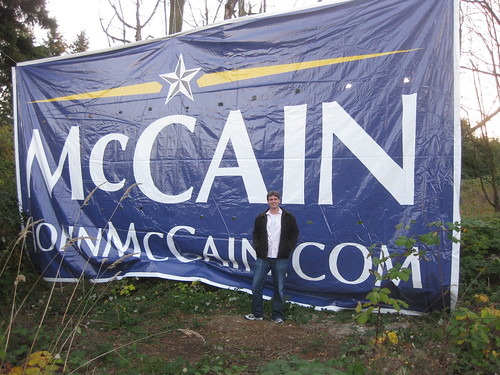
Meanwhile, across the trenches on the other side of the battlefield, the thinking is that if a small sign is easy to steal then a big sign is hard to steal. So he put up a big sign!


Friday, October 24, 2008

New York Times makes endorsement

From today:

Mr. Obama has met challenge after challenge, growing as a leader and putting real flesh on his early promises of hope and change. He has shown a cool head and sound judgment. We believe he has the will and the ability to forge the broad political consensus that is essential to finding solutions to this nation’s problems.

In the same time, Senator John McCain of Arizona has retreated farther and farther to the fringe of American politics, running a campaign on partisan division, class warfare and even hints of racism. His policies and worldview are mired in the past. His choice of a running mate so evidently unfit for the office was a final act of opportunism and bad judgment that eclipsed the accomplishments of 26 years in Congress.


Obama in Virginia

Here are some photos and audio of an Obama rally in Virginia.

So what, you might ask.  Well, in the presidential election of 2004, Bush won their 13 electoral votes over Gore by 52.2% to 44.4% (Nader took 2.2%).  The most recent poll results have Obama up 51.5% over McCain's 44.5%.

That's a turnover of 15.1% points in a very reliable Republican state.

Nationally as of today, Obama has raised $621,984,626 in total with $133,696,693 cash on hand and just 12 days to go. 

Obama is no longer a campaign - he leads a movement.

Thursday, October 23, 2008

US election images

There are lots of great US election images out there - here are just a few of Obama.


Wednesday, October 22, 2008

Barack Obama - the early days

http://www.papermag.com/blogs/barack-obama-bw.pngThis video is worth checking out: it's a series of interviews from 2001 to 2004 which provide some sense of Barack Obama before he became a political god.

Back then he sounded more like the constitutional prof that he was than the national figure channeling Martin Luther King before teeming crowds of thousands.

Tuesday, October 21, 2008

Political reaction(aries)

I would have thought that the US white power nazi and assorted groups would have been very active in this US presidential election. It seems not so much. The New York Times reports that they are doing the best that can but mostly they are too marginalized, weak and divided even on the issue of whether Obama is really all that bad.

On the other hand, more mainstream groups like the Chaffey Community Republican Women, Federated, seem to be filling the gap with foolishness like an illustration of "Obama Bucks" -- a phony $10 bill featuring Obama's face on a donkey's body, labeled "United States Food Stamps."

More creepy is this report from the Washington Post which tells the story of the racism encountered by Obama campaigners:
They've been called racially derogatory names (including the white volunteers). And they've endured malicious rants and ugly stereotyping from people who can't fathom that the senator from Illinois could become the first African American president.
Meanwhile, some local rednecks get themselves organized in West Plains, Missouri. These local enterprising political stars put up a billboard reflecting their sophisticated political views.

Not too far away is the obligatory hanging-in-effigy incident. USA Today notes that:
The hanging of the effigy around the neck is seen as racist symbolism because it harkens back to lynchings of black men by white mobs, especially in the U.S. South, decades ago. Obama is aiming to become America's first black president.
No kidding.

And then just when you thought you had seen and read it all, you come across this huge steaming pile of absurdity. RightPundits.com, which received a secret copy of Michelle Obama's Princeton dissertation says that:
The excerpts show that Obama identifies with black militancy, utterly obsessed with race in America and her own blackness. It is a fundamentally racist document, shocking when considering that this scholarship is the product of a presidential candidate’s wife at a great university.
In the land of free speech, anything goes.

Thank you for your service


I hope he stays near.

Sunday, October 19, 2008

Sign Wars update

I received an email:
You wrote: "I always looked on sign damage as the unimpressive work of political campaign amateurs. Clearly others disagree."

Would you mind explaining what you mean by "others disagree"? I am in agreement with your thought on that it's opposition campaign followers who are doing the destruction/vandalism.
Interesting question.

Generally, I think there always a percentage of signs that get knocked over or punched in or taken due to any of random vandalism, the disgruntled and bored or special cases of metal illness or what have you or the casual bump that knocks down a poorly planted sign. That happens all the time in every election to one degree or another.

There's a big difference between those random acts and deliberate predation. That is uncommon, though not rare. It's not common enough so that when it happens, you notice it and vice versa. It's the damage that falls way outside the norm that's the tip-off. When a whole parkway disappears or all the 4x8s in an area are spray painted the same way, it's not an accident. Often, but not always, it's predation. If it happens a second time, that confirmations predation.

Search media reports and the stories pop up. Some are whining candidates making baseless accusations, no doubt. But there are also the cases documented by legal action or even just videos and photos of people caught in the act.

And I'm leaving aside the issue of fair comment versus vandalism. I know the "record of lying" case took in more issues than just simple vandalism. The line is not as thin as you would think. On some levels, some cases straddle that line between vandalism and free speech. A fundamental underpinning of civil disobedience is "do the crime, serve the time".

I still think sign damage is the unimpressive work of political campaign amateurs not necessarily attached to a campaign though they might be. It's an unusual campaign that tolerates it; some candidates set explicit derectives prohibiting it.

It's just foolish on a whole bunch of levels for all concerned.,of which the ethical and criminal problems are just two.

Campaigns need to keep their eye on the ball and remember that the goal is to get your point across to the voters. But as obvious as all that might be there are people who think otherwise; signs just don't self-destruct or evaporate.

Wholly bizzare

This video sent chills up my spine.


This is how the Arab/Muslim world will frame this US election. Did you catch the fact the clip came from the Aljazeera tv network?

Sign wars

Barack Obama for President Yard SignPolitical signs around here are free; campaigns just give them away. Locally, these are usually the first advertising expense of the campaign (after design).

In the US, signs are sold to raise money for the campaign. They are not an expense, they are a profit center. The handsome sign on the right can be yours for a measly US$8 ($3 for 500 or more) plus appropriate taxes and shipping.

These cost the campaign less than $1 each in volume. And I can guarantee you that the sign company who hooked the Obama contract will retire after this on the volume they will order before the campaign is done.

There are many fronts on which campaign wars are fought. The air wars are the media advertising and talk radio appearances. The ground war is the volunteer house-to-house canvassing organization. Then there are the sign wars: who gets them out the firstest to the best spots and the mostest by election day. They are erected by the campaign corp of engineers. who can pop up vertical 4x8's across the city like mushrooms after a summer rain.
One of Kevin Breen's campaign signs was altered to showcase the words 'a record of lying.'
That's the overt part of the sign war. The dark side this war's covert exercises are the signs that evaporate in the night, destroyed, marked up (a la Ray O'Neill) or otherwise defaced. In the Federal St. John's West By-election held in May 2000, I remember that all the campaigns (except the Reform, oddly) saw massive damage to signage.*

Now that we've come out of a nasty federal election in which sign wars played a part again, I think it's worthwhile to keep in perspective that sign wars happen in other places too.

But when you are making $7 per sign and people are willing to replace them, the crime is a whole lot less financially traumatic to the campaign.

---------------------
* I always looked on sign damage as the unimpressive work of political campaign amateurs. Clearly others disagree.

Friday, October 17, 2008

Insurance for bloggers

The Media Bloggers Association is now offering the same training, legal support and insurance previously only available to traditional media organizations. This will include BlogInsure, a first of its kind liability insurance program for bloggers which provides coverage for all forms of defamation, invasion of privacy and copyright infringement or similar allegations arising out of blogging activities.

NL bloggers should be quick to follow up on this.

Thursday, October 16, 2008

Federal Election ABC Aftermath

Two interesting articles on trying to foretell the effects of the federal election of federal-provincial relations.

The New Brunswick Telegraph figures their province is in the catbird seat. They just elected 6 Cons out of 10 seats so they predict they can plough ahead with their "energy hub" projects with full federal support. The NL future is not so bright:
A major factor was Newfoundland and Labrador Premier Danny Williams' acerbic campaign against the Harper government, which succeeded in shutting the Conservatives out - with six of that province's seven seats going to the Liberals and the other to a New Democrat. But Mr. Williams has also shut his province out of any representation in the new government. That's where revenge gets you.
Then there is Ontario and the contrast between the incendiary Williams approach and the more low-key McGuinty tactic. The Globe figures that while McGuinty has some room to play with, Williams has not so much:
But what if the day isn't done and what if Mr. Harper has a long memory for those who have crossed him? What does Mr. Williams have left the next time he wants to be threatening? Will the Liberal and New Democratic MPs from Newfoundland be able to protect his offshore energy accord when the equalization scheme is reviewed again?
Life has become no less interesting.

Behind the scenes at "I have a dream"

From the New York Times obituary of John R. Reilly, a close adviser to a string of Democratic presidential candidates since the Kennedy years:
On Aug. 28, 1963, when the Rev. Dr. Martin Luther King Jr. gave his “I Have a Dream” speech before 250,000 civil rights supporters in Washington, Mr. Reilly was given an unusual assignment by the Kennedy administration.

As the television correspondent Roger Mudd wrote in his book “The Place to Be: Washington, CBS and the Glory Days of Television News” (PublicAffairs), Mr. Reilly told him that “he was stationed at the Lincoln Memorial, equipped with a cutoff switch on the sound system if the rhetoric got too inflammatory. ‘We had a turntable hooked up to play music, if necessary,’ Reilly said.” Mr. Reilly had picked a 78-r.p.m. recording of Mahalia Jackson singing “He’s Got the Whole World in His Hands.”

Imagine if he had hit that switch. . . "Free at last. Free at last. Thank God almighty he's got the whole world in his hands!"

Wednesday, October 15, 2008

Unite(?) the Left

This election, the NDP ran as good a campaign as it was possible to run under the circumstances. It was tight, well-scripted, logistically near-flawless and fully funded for the first time. They had a leader who, arguably, made fewer mistakes than the others (outside the occational skinnydipping dopehead) and reached out to people and places ignored by previous NDP campaigns.

The national NDP results were pretty good. The party attracted 2,517,075 votes or 18.2% yielding 37 seats and 67 second places. Compare this to the 2006 general election where the party attracted 2,589,597 for 29 seats and 53 second places. And the budgets? $13,524,525 in 2006 compared to an estimated $20,000,000 this time.

But after spending almost 50% more money, or $6M, the party attracted a mere 8 additional seats and a relatively minuscule number of additional votes. And they never broke the 20% barrier.

Have they, as one comentator put it, hit the orange ceiling?

It's time for the NDP to explore the idea that they have gone as far as they can under their current party structure. The question is Are theose in charge of the NDP is willing and able to pay the required price for greater success.

Can they cut the formal structural ties the party currently has with the Canadian union movement.

To put it another way: Would you vote for a party which reserves 25% of policy convention delegates to affiliated union organisations? Or would you vote for a party which reserves 25% of leadership convention delegates to affiliated union organisations? Yet that's standard operating procedure in today's NDP party.

Would you feel any better if 25% of your party's delegates came from the Canadian Chamber of Commerce? Or maybe the Quebec Major Junior Hockey League? Isn't one special interest group equivalent to any other?

Tony Blair, early in his tenure as leader of the Labour party faced this choice. He had the courage required to make fundamental structural changes to his party. He cut ties to the British labour movement and thus modernised his party to turn it into a real alternative to the Conservative party.

Is Jack Layton ready to do the same?

Which brings us back to the Unite the Left movement. This is a popular trope among casual political observers and the argument is a simple one: in order to confront the menace on the Right, the Liberal party and the NDP (and possible the Greens) must and should unite under one banner in order to prevent vote splitting.

After all, didn't Reform and the Progressive Conservatives successfully unite? Sure they did. And it took years of negotiations, talks and compromises to make ithappen. Couldn't the Liberals and NDP do the same?

In the long term, it's possible.

But Canada does not want or need the further polarisation of national politics between the hard-right to center-right umbrella that is the national Conservative Party on one side and a creature of the Canadian union movement on the other.

No responsible federal party should ever be as beholden to national organised labour as the NDP party is now.

If there is to be a true Unite the Left movement, the NDP will have to agree to shed it's formal union ties as a precondition to those talks.

Tuesday, October 14, 2008

Not just around here, it seems

I've been looking for a good term for the degradation of public debate that's occured in NL over the last few years.  I've finally found one.

Chris Buckley, son of US conservative great Bill Buckley, has resigned from The National Review, the conservative magazine founded by his father.  After he endorsed Obama, he and the publication have been flooded with vitriolic, vicious reaction from the US right.

His conclusion: "(it's) part of the calcification of modern discourse".

It's a good line.

Space and Russia

Two subjects that have always fascinated me are the space program and the USSR. So when I run across stories about the Star City cosmodrome at Baikonur in Kazhakztan, the former super-secret Cape Canaveral Russian equivalent, I'm hooked.

These days Star City is no longer supersecret. In fact, due to the closure of the US shuttle program, for a fiver year period until the US gets the replacement vehicles ready, the only way to get to the International Space Station will be through Star City. It was huge Russian Proton rockets launched from Star City which transferrred the ISS into space.

So here's a piece from the New York Times outlining the US experience with Star City. In part:

Those early days (1994) were also marked by wariness and distrust, and the first Americans had a strong impression they were being watched. Mark Bowman, an early contract employee in Russia who is now back in Moscow as deputy director of NASA’s human space flight program in Russia, recalled a weekly teleconference with his boss in Houston. “Thirty minutes into the call the line would go dead,” Mr. Bowman said. “And that would happen every 30 minutes.”

One day during the teleconference, Mr. Bowman warned 28 minutes in that the line was about to go dead and said testily, “I sure wish these damned KGB guys would get longer tapes.”

“The next telecon we had,” Mr. Bowman recalled, “I swear to you, it went 45 minutes and then it went dead.” Apparently, he said, his hosts had upgraded to 90-minute cassettes.

Friday, October 10, 2008

More federal election information

While Trendlines might be the ugliest website ever (outside the first dozen or so that ever went online) it has some interesting seat predictions based on averages of polls and available seat prediction models. It is sort of an aggregate seat predictor.


As of today, they predict C131, L105, BQ42, NDP28 and 2 independents.

It's worth a look.

So very tired

One of the very best political movies of all time is The Candidate starring Robert Redford. It's a great film with keen political insight (it won an Oscar for best screenplay written by Jeremy Larner, a speech-writer for Senator Eugene J. McCarthy during McCarthy's campaign for the 1968 Democratic Presidential nomination).

Political chronics will know the film but for those who don't, it's about a young political candidate for Governor of California. There are many twists and turns in the story but a great moment occurs late in the campaign. Redford is in the back of the limo heading to election event number 1,654,385 or so when he starts repeating his stump speech to himself. He has delivered it so many times that the speech becomes meaningless to him; the words come out in a meaningless and bizarre jumble of phrases and ideas. His handlers, listening to him from the front seat, look at each other with a look that tells you they think he's lost his mind.

That's what happens in long campaigns: candidates gets punchdrunk and silly because they get tired. Ever take a flight across Canada? Now take one every day, back and forth, for a month. Then try to pass any kind of test of concentration.

Wondering if Peter MacKay knows what candidate he's stumping for today? Of course he does. But after 30+ days on nonstop travel, he's lucky to know his own name.

Wondering if Dion knows his own economic plan? Again, of course he does. Again, after 30+ days on nonstop travel, he's lucky to know his own name.

Are Harper's efforts to seize on Dion's mistake to his own advantage underhanded? I don't think so - it's just politics. Maybe, as a political tactic, it's not as effective or as smart as it could be. But it's still just politics nonetheless.

Is it bad journalistic ethics to run the flubs on the air in toto? I'm not sure because I'm not an expert in the area. But I'm not sure what journalistic purpose was fulfilled in doing that.

I'm not excusing the flub on tiredness or hearing or language. After a campaign this long, there are no new questions and the answers should become automatic. Somehow, in this case, the autopilot went on strike and his brain locked up. It is not a comment on his competence; it's a confirmation of his basic human fallibility.

This is not a good way to end the last week of the campaign.

Thursday, October 09, 2008

What happened in Iceland?

BBC has a great analysis piece on what happened to cause Iceland to collapse. In short, inappropriate monetary policy and an outsized banking system made for a toxic combination.

Long terms prospects are good; short term prospects not so good with Icelandics seeing payments on loans increased by up to 50%, and inflation which may reach 30% or more this year, with salaries frozen and mass layoffs to come.

Stay tuned

The image of change (or the changing image)

[dion+much+music.jpg]

Spot the narcissist

Research shows that narcissists like to become leaders.  But while they really want to become leaders, they are not any better than anyone else at being a leader.

Anyone closely involved in watching politics could have told you that.

A sobering commentary

From the Globe today:
At worst, we could wind up like Italy - broke, with a pizza parliament, but without the food, art and fabulous shoes.

The importance of being ernest

Image from “Mr. Harper's empathy deficit”

Wednesday, October 08, 2008

Great image

Image from “Harper offers policy, not an empathetic ear for Canadian concerns”

 . . . although Mr. Harper may not agree.

The Canadian Polity

Tom Flanagan is not just the Prince of Darkness of the Reform/Alliance/Conservative braintrust, he is also a respected political scientist. And he has interesting things to say today in the Globe including:
My long-term prognosis: Whether the Conservatives win a minority government (a majority now seems out of the question) or the Liberals stage a comeback to win their own minority, we are in for years of fragmentation. Usually, a period of splintering would be followed by consolidation, as happened with the Canadian Alliance-Progressive Conservative merger, but our system of finance tends to turn advocacy groups into parties and keeps them alive even after they have outlived their usefulness.
Also in the Globe today is a quick overview of the role of provincial premiers in this federal election:
Then there is Danny Williams of Newfoundland and Labrador - a Conservative who legally registered his "Anyone But Conservative" campaign with Elections Canada, calls the Conservative Prime Minister "intolerant" and predicts a "dark age" if the Conservatives get a majority.

The "fighting for you" game worked well for Joey Smallwood, Frank Moores and Clyde Wells, and it's been working for Mr. Williams.


The national view? Williams is same-old-same-old.

No more talk of Iceland

Not long ago, the NL government was full of talk of the Icelandic model as the one to go by. This was after the period when government was smitten by the Celtic Tiger model.

Like us, these places they were small and plucky. If only we were more independent then the match would be complete and we could be just as successful as they.

Last August, I wrote here that the Iceland as a model was deeply flawed and that it was just a matter of time and the right circumstances before Iceland tipped over into the economic abyss.

Turns out I was right; they are the country worst exposed to the credit crunch with banking debts several times bigger than its economy, their central bank have ditched a currency peg after failing to convince investors it could maintain it, IMF officials are flying in to offer help, Britain is threatening to sue and and now they are in loan talks with Russia!

The goal of the Icelandic government is to stave off complete national financial collapse. Like NL in the 30's, Iceland is staring national bankruptcy in the face.

Maybe the NL government was right to look at Iceland as kindred spirit after all - we can send them a delegation to consult on how to set up and operate a Commission of Government.

Tuesday, October 07, 2008

New (to me) election info sites

If you are looking for even more information sources about the federal election (and who isn't?) check these out:
  1. Chronic political junkies are already familiar with RealClearPolitics, an American site with great polling data for all the different US races going on.  Well, now there is a related site, RealClearWorld.com that tries to do the same thing for the rest if the world, including the Canadian federal election.
  2. This is one of the most interesting political info sites I've seen in a long time.  Pundit's Guide is an embarrassing wealth of political data broken down all different kinds of ways.  Want to know about Floor-Crossers and Party Affilliation Changers or Nominated Aboriginal Candidates To Date?  This is the place to be!
Enjoy!

Friday, October 03, 2008

Sarah Palin debate instructions leak

This just in. . . Sarah Palin's leaked debate instruction notecard!
Photo

Thursday, October 02, 2008

Everyone has economic jitters

Somebody is on the ball

BushHarper.com

It was just a matter of time.

Very impressive

It takes quite a story to pop up simultaneously on BBC, CNN, the New York Times, The International Herald Tribune, Bloomberg, The Telegraph (UK), Irish Times, Reuters, China View, Press TV (Iran), Hindustan Times, The Observers (France), TVNZ (New Zealand), never mind the Australian media.

The Harper communications/speechwriting staff should be very proud.

Wednesday, October 01, 2008

Dion in French and English

Too many times in the course of the day I hear complaints about Dion's English and too many times I have to leap to his defense.

I think my sensitivity to the issue comes from the fact that mom was a francophone who only learned English late in life, much like Dion. I understand him perfectly well because it's an accent I'm used to.

It turns out that part of Dion's problem is a common congenital hearing problem.

I've argued that Dion's English, minus his accent, is more sophisticated in structure and vocabulary than that of most native English speakers. Just look at this quote from the story noted above:

But he said it (the hearing problem) affects his ability to "catch the music of the beautiful language of English."

"I hear everything when it is isolated, but when it is confused with other sounds it is completely confused," Dion, 52, said Monday during a campaign stop. "My mother has the same problem. It is kind of a hereditary problem, but it does not stop me from listening to Canadians.
When was the last time you heard a politician refer to catching the music of the beautiful language of English? Need I make the comparison with the local politicos who drivel endlessly about "piece of due diligence drill-down on a go-forward basis at the end of the day, to be honest"?

And that seems to be part of his problem. Because he does not dumb down his remarks when he switches to English, native English speakers are caught trying to follow complex and sophisticated remarks on top of hearing them in an unfamiliar accent.

Maybe he should just dumb done his remarks in both official languages. He could do that. But then he would not have attracted my attention or my support.

This article goes some way to help explain the issue of Dion and his English.

Biden and Palin face off

Tonight is the French language Canadian leader's debate.  And as much fun as that will be, more fun will be the debate between Joe Biden and Sarah Palin.

As expected, there are lots of material and analysis about the participants and how the debate might play out.  Here is some of the best commentary thanks to the old grey lady (New York Times)

This is a short video outlining the styles and expectations of the two.  There there are these two articles dealing with Biden and Palin separately.

This will be a great show.  Without sticking my neck out too much, I expect Palin will be pulverized.

Tuesday, September 30, 2008

Harper copies Australian Prime Minister John Howard

Congrats to the Liberal staffer who found this.  They earned their pay this week.


What's the difference between a liberal and conservative?

According to this article:
Political conservatives operate out of a fear of chaos and absence of order while political liberals operate out of a fear of emptiness, a new Northwestern University study soon to be published in the Journal of Research in Personality
Now we know.

Friday, September 26, 2008

When the Rock Gets Rich

From Macleans Magazine. . . .

The timing is a bit arbitrary, but at some point in the next year and a half, the province of Newfoundland and Labrador will slip over from being a "have-not" province to a "have."

Just like that.

What a sea change this will represent. The lowest man on the totem pole shooting up past its Atlantic province siblings, past the historic rival (Quebec), past Manitoba to survey the sunny economic uplands of Canada, there to sniff the purer, rarefied air that has been so unquestionably the right for so long of Ontario and the affluent western provinces.

A lighter campaign moment

Time for Some Compaignin'

(turn up your speakers)

Thursday, September 25, 2008

Generic political stump speech

From Scott Feschuck:

My fellow Canadians:

Election day approaches. We have as a nation arrived at a juncture near a precipice that is located alongside a crossroads on the edge of the potential of a new horizon. So, please, watch your step.

My friends, I have been traveling our vast country to spread the message that we must bring change to Ottawa. But not just any kind of change. It must be bold change. It must be progressive change. It must be crazy change. I’m talking about change for its own sake – wild, flailing change unburdened by rational thinking.

My opponents talk about change, but what kind of change will they bring? Will it be unthought-through enough? Will they, like me, replace O Canada with Sign of the Gypsy Queen? Because I’ll do it. If it makes you vote for me I swear to God I’ll do it.

In the 21st century, we must move Canada forward, not backward. Upward, not downward. Diagonal, not perpendicular. Also, Barack Obama was on CNN talking about the world becoming more competitive. So we should probably look into that, too.

Now is not the time to retreat to the garrisons of fear or the barracks of prejudice. Now is the time to push ahead toward the huts of progress, the condominiums of hope and that huge castle of unicorns. You see the one I’m talking about? Next to the Arby’s of common purpose? Just hang a left at the forest of metaphor.

Let me say for the record that my rivals in this election are good people. They are decent Canadians who happen to require medication to combat their fetishes and chronic narcolepsy. In their defence, there is nothing in our Constitution that disqualifies a Canadian from seeking public office just because he killed a hooker.

Besides, I want this to be a campaign about the issues. I want my words to serve as eloquent testament to the power and virtue of my ideas. For more on my solemn commitment to elevating our public discourse, please visit my website. Just click on the ostrich that’s taking a leak in my rival’s ear.

My friends: this is the most important election since Canada was formed, since democracy was birthed, since prehistoric man gathered to focus-group the discovery of fire (consensus: too orange). The differences between my positions and those of my rivals are enormous and critical.

I would lower your taxes by a negligible amount. My opponents would lower your taxes by a slightly different negligible amount. I would reduce greenhouse gas emissions eventually. My opponents would reduce greenhouse gas emissions ultimately. I believe children are our future. My opponents told me they think your children are ugly and stupid. (You’re not exactly easy on the eyes yourself, they said.)

People of Canada: I come before you tonight as just a man – a humble, ordinary man wearing a sweater selected for me by a team of stylists and advisors. The sweater is powder blue: feminine enough to appeal to women 35-44, with just enough navy undertones to keep men from actively debating my sexual orientation. Got it at Banana Republic.

At this point, I would like to mention my family in a forced and obligatory manner.

I love my family. My family provides me with strength, spiritual nourishment and heartwarming anecdotes for my television commercials. Basically, I’m just a family man. In fact, I’m such a family man that one family is not enough for me. I must travel the country meeting other families, entering their homes and yards trailed by 50 reporters, pretending to find their children adorable. There may even be a family standing awkwardly behind me right now. There usually is. Hello, Wongs. What’s that? But I asked you if you needed to go before the speech, Grandma Wong. Just hold it, OK?

In conclusion, let me say: Canada is a country whose health care system defines us - as a nation with tremendous patience and a high tolerance for pain. Canada is a country with old people in it, and they must be pandered to, often while using the word “dignity.” To them I say: you deserve to live with dignity!

From the down-home hospitality and fishing villages of the east to the open spaces and soaring mountains of the west, Canada is a land of bounteous clichéd images used by politicians to crudely evoke patriotic sentiment. Also, there are Prairies.

Canada is a great country. In fact, it’s the greatest country in the world. What I’m saying is: Portugal can suck it. Ditto Japan. Those places are holes and we all know it. Don’t even get me started on Greece.

I shall now speak French in a manner that suggests I’m merely repeating what I just said in English – when in fact I’m telling Quebecers they’re my favourites and giving away the farm.

Political interviews

With a federal election on the go, the airwaves are full of interviews with one politician or another. And they all have one thing in common: they are dreary and boring.

So it's refreshing to see an interview like this one with an Australian senator on the issue of a oil tanker mishap.

Tuesday, September 16, 2008

Online Election Predictor

I know at least 1 purist who denigrates this little election toy (ya, Wally, that's you) but suffice it to say that this software device is not legal for trade.

It is kinda cool tho. With the latest Nanos numbers, it predicts a Con minority with more seats for them, the Libs and big losses for BQ (C:139, L:113, N:27, BQ:28).

Williams Government intimidation

Nothing could be further from the truth?

Time will tell.

Monday, September 15, 2008

A public service message

Enjoy!

Fratricidal politics

From CTV News on 2008.09.14

SANDIE RINALDO: Well in Newfoundland it's not just Conservatives going after the NDP but provincial Conservatives going after federal Conservatives. Is this going to hurt?

ROBERT FIFE (Reporter): It is going to hurt. The Liberals expect they can win, think they can possibly win all seven seats here. The Conservatives had held three, or currently hold three of those seats, and that's because Danny Williams is on the warpath. He's bound and determined to defeat all the Conservative candidates. In fact federal Conservatives are saying he's using intimidation tactics to scare Conservatives away from voting for federal Conservatives. Danny Williams says that isn't true.

Sunday, September 14, 2008

Saturday, September 13, 2008

"You may know them as transcripts, ma'am"

A little more Ryan Cleary.

The wisdom of Rex


Danny boy has gone too far 

It's too bad Loyola Hearn, who was the Newfoundland minister in the Harper government, is not running again. After a long career in politics, he has decided to leave the game. 

Mr. Hearn is a very decent man, a product of the great coastal stretch outside St. John's we call the Southern Shore. He is an "outport" man, just as Danny Williams is a "townie." The health of Newfoundland has always, by some peculiar chemistry, depended on a dynamic equilibrium of its outport and townie components. 

Today, after the collapse of the cod fishery and with the near co-incidental explosion of offshore oil, the outport dimension of Newfoundland is almost in ruins, while St. John's and its suburbs are rich and active as never before. There are two Newfoundlands. 

The capital city and environs are in a fever of development, while vast stretches of coastal communities are inert and underpopulated, mere phantoms of what once they were. 

Mr. Hearn's retirement deprives Newfoundland politics of a necessary voice, one suited by temperament and background to speak on the overwhelming subject of the accelerating extinction of Newfoundland's quintessential outport heritage. 

This is not the only unhealthy imbalance in the province. There are 48 seats in the House of Assembly, and Mr. Williams owns 44 of them. The Liberals, with three, are the rump of a rump, and the NDP, with one, is a vapour. The numbers tell it: Mr. Williams is king of the Rock, the most powerful politician since Joey Smallwood. 

Newfoundland politics has shrunk to oil and Danny Williams. 

There are only two ways of doing politics now: Mr. Williams's way, or no way at all. Those who cross him, in what he sees as "Newfoundland's interests," are given short shrift, and none too subtly derided as working against Newfoundland. This was a Smallwood turn, and the least attractive aspect of his quite mixed political qualities. 

In his last and bitter days, he turned Newfoundland politics into a one-man show incarnate. 

That's why it was so very unfortunate that when Mr. Hearn - who, while he may not be as good a politician as Mr. Williams, is at least as honourable a Newfoundlander - said he was retiring, Mr. Williams issued this statement: "The one thing that my cabinet ministers have done throughout is stood up for their constituents, for the electorate and the people they were elected to represent and they have done that. 
And it's unfortunate in the last few years that Loyola hasn't done the same thing. "Oh, cut it out. This "standing up for Newfoundland" palaver is best administered in small doses, if at all. And it never fits the mouth of the person doing the "standing up." Furthermore, a difference of opinion, a clash of party interests, should never be categorized as a clash of patriotism. There is a jingoism of small places as well as of large. And Newfoundland is more susceptible to it than most. Newfoundlanders are ferociously fond of Newfoundland, but that very affection can play havoc with our judgment and our politics. 

The idea that Mr. Hearn, because he disagreed with Mr. Williams, acted with less than honourable intent toward Newfoundland is ludicrous. 

Mr. Williams, in fact, is a much better man than his own statement would have you believe. 

And now that the federal election is on, Mr. Williams has thrown himself with gale force into the campaign. He sent an e-mail to his entire caucus to determine whether they were on-side in his campaign against "Steve." And out of the 44, there was only one spine. It belongs to Elizabeth Marshall, who earlier - this is the distilled version - quit her cabinet job because she wasn't going to put up with the Premier running it for her. Only Ms. Marshall didn't respond with the ovine bleat, Yes, sir, yes sir, three bags full. The others signed on. 

It's not Mr. Williams's quarrel with Stephen Harper that's at question. It's hauling into that quarrel all the rhetoric of "disloyalty" to Newfoundland, stirring the jingoistic fevers, and characterizing those on the other side as unworthy. Newfoundlanders have been lucky in past decades that, when we had strong premiers, we had strong ministers in Ottawa. 

Danny Williams has reached such supremacy, however, that he has effectively become the only voice in Newfoundland politics. Mr. Hearn is gone. John Crosbie is in honorific heaven. And now there's only Danny. That's bad for us. It's bad for him, too, should he care to think about it. 

He should look over history's shoulder and take in what happened to Joey Smallwood, a great premier who subtracted from his own legacy by succumbing to the vanity of power, the great corrosive self-flattery of believing that being in charge is the same thing as always being right.

Friday, September 12, 2008

Federal Election - Week 1

We learn that this politics thing might be harder than it looks.

Nationally, even!

Let's see if it gets better.

Friday, September 05, 2008

Saturday, August 30, 2008

Famous failures

It's not as bad as it looks.

Friday, August 29, 2008

Democratic Speeches

It's easy to dismiss US political speakers as boring and dreary but the truth is that they are like speakers here or anywhere - some are boring and dreary but others send shivers up your spine.

Keep in mind that not all speeches that are written are ever delivered. Great words and phrases are sometimes left on the oratorical equivalent of the cutting room floor.

Here are two worth checking out from the US Democratic convention compete with text and structure. These two speeches are Democratic political bookend speeches. The first is from Senator Edward Kennedy, rising from his sick bed with what might be his last great speech he will ever give before he inevitably succumbs to brain cancer. The second is the acceptance speech from Barack Obama as he launches into the general election campaign.

The first is a heartbreaker of a speech while the second points to the future and together these two speeches represent an historic transition.

Enjoy.

Friday, December 07, 2007

"A date which will live in infamy"

Today is the anniversary of the bombing of Pearl Harbor.  The following day, on December 8, 1941, President Franklin Delano Roosevelt delivered his declaration of war to a joint session of congress.

This speech is one of the most famous of the 20th century.  FDR made a deliberate decision to deliver a brief, uncomplicated appeal and decided against a thorough recitation of Japanese perfidies, as his Secretary of State urged.

After delivery, normal procedure was for him, or a staffer, to take the speech back to the White House for filing.  On that day, the speech was left behind and presumed lost.

That speech was composed by FDR himself, first in his head, then dictated to a secretary and then revised from typed copy.  It was truly a product of the man himself.

In March 1984, an archivist located his reading copy among the Records of the U.S. Senate.  It turned out that when FDR left his copy behind, it was picked up by a Senate clerk who took charge of it, endorsed it "Dec 8, 1941, Read in joint session," and filed it.

Delivered at a pivotal moment in history, it is clear, unambiguous, elegant, forceful and appropriate.  You can see from the scans below that he revised right up to the last draft.  The famous line "a day that will live in infamy" was revised by him by hand from the original " ... live in history."


Power

Mythbusting - What if NL did the same?

Then a few scattered blogs here and there would vanish from the ether, I'm sure.  As would some newspapers.

On the other hand, others have been doing yeoman's service in carefully and systematically demolishing longtime received "truths".

When you base choices for the future on myths of the past, don't be surprised when things go awry and others look askance at you.

Simpson's column today covers another province looking hard at myths of their past.  We are overdue in doing the same.

---------------------------

Hard sell: What if Quebeckers turned their backs on false history?

In the dream palace of Quebec's existential politics, articulate and forceful federalists are at a premium.

Provincial politics has evolved into a competition among secessionists (Parti Québécois), autonomists (Action Démocratique) and federalists who seem chronically unhappy with most aspects of the Canadian status quo (provincial Liberals).

Federally, politics plays itself out among secessionists (Bloc Québécois), asymmetrical federalists (NDP), Quebeckers-are-a-nation (Conservatives) and Stéphane Dion Liberals. That the Liberals are now third or even fourth in Quebec says much about the leader, and attitudes toward federalism.

Federalism is a devotion in Quebec that often dares not speak its name. That it might be an excellent form of government, and beneficial, is an argument seldom advanced, except in cold mechanical terms in which Quebec's financial "gains" are recorded, then quickly forgotten in a welter of fresh demands.

It is, therefore, refreshing (although likely not consequential) that a group of federalists recently produced a collection of essays defending federalism. That the authors are swimming against the tide of elite opinion in Quebec makes their enterprise the more laudable, since they represent the few voices ready to state their federalist credentials clearly and largely without equivocation (although the contribution from the ADQ representative is as muddled as the party's attitudes toward Canada).

Reconquérir le Canada was the brainchild of André Pratte, editorial pages editor at La Presse. It brings together academics, political organizers, past candidates for the Conservatives, Liberals and ADQ, Quebec Intergovernmental Affairs Minister Benoît Pelletier and former federal Liberal justice minister Martin Cauchon.

Even among these redoubtable federalists, however, an undercurrent of dissatisfaction exists with current constitutional arrangements. Most of them say further constitutional changes (at some point) will be required to "satisfy" Quebec by way of allowing the province to sign on to the Constitution that the PQ government did not accept in 1981.

The time is obviously not right to reopen constitutional discussions (will the time ever be right?), but many of these authors suggest it must come.

Mr. Pelletier observes, correctly, that politics in Quebec is driven by identity over language, institutions and other manifestations of the "nation."

History, too, indelibly shapes the collective sense of the "nation," and that sense is exceptionally strong in Quebec. It is also a received sense, in that it is handed down in a certain way, largely as a trail of tears for Quebec within Canada, offset by ephemeral triumphs by provincial politics to "defend" the interests of Quebec.

Mr. Pratte's essay, therefore, is the bravest and most interesting because it is the most iconoclastic, for he takes issue with some of the received assertions of Quebec history.

The Conquest, for example, was a trade of one colonial master for another, and it allowed francophone Quebec to join the winning team in world affairs for the subsequent century and a half -- which meant the Industrial Revolution, parliamentary government, rule of law, and huge export opportunities, all while retaining its language and religion.

The Second World War is presented in Quebec as a doughty struggle against conscription wanted by les anglais, whereas, as Mr. Pratte points out, francophone Quebec's Pétainist preferences and its cultural/religious elites' disengagement from the fight against Nazism left too much of the province on the wrong side of history. To this day, Quebec has not faced up to that sad chapter in its "national" history, preferring the self-comforting saga of valiantly opposing conscription.

Mr. Pratte also takes issue with the premise that the Quiet Revolution turned a backward society toward modernity. Quebec, he argues, had an entrepreneurial class and spirit long before the 1960s.

Quebeckers, he urges, should be more outward looking, more embracing of the idea they can succeed in Canada, and less reliant on the clutches of false history that lead them toward the comforting but inward-looking options of secession and disengagement.

This is the book's most important idea. It will not be an easy one to sell, given the intellectual forces, conventional wisdoms and political choices ranged against it.

Thursday, December 06, 2007

Dirty politics

It's all over but the nastiest politics has to be about candidates and their religion.

It's bad enough when you think certain candidates might be questionable but when God tells you they are bad, well, you get something like this video aimed at Mormon presidential candidate Mitt Romney's wife, Ann.

Evel Knievel makes last jump

Robert Craig "Evel" Knievel, Jr. recently passed away on November 30, 2007.

It's hard to describe who and what Evel was but this comes close:

Evel Knievel was kitsch. He was an Elvis who couldn't sing. He was a stuntman without a movie. But none of that mattered.

As my friends cheered, I saw that Evel Knievel was a visionary. Decked out in his Captain America jumpsuit, he created the first and perhaps the greatest reality show of all time. He embodied the American dream: getting paid to take risks, and getting famous along the way. In less than 10 years, he made $60 million in exchange for 40 broken bones, multiple concussions and a coma.

Monday, December 03, 2007

Hypocrisy unbound

From today's Telegram's jeers and cheers:

Jeers: to a reality check. Wednesday, the province's Liberal opposition party asked the board that oversees the affairs of the House of Assembly for more money than the rules would normally give them, saying they needed the funds to be an effective opposition. They asked for $450,000 - the ruling Conservatives offered $100,000, saying they had to protect the taxpayers. Here's some of the comments: "You can't always get what you want. This is the people's money. We have to spend it wisely." - Finance Minister Tom Marshall. Cost of operating Marshall's ministerial office last year: $283,900. Cost this year: $339,100. Single-year increase - $55,200, or 19.4 per cent. "I would think that the request before us now is pretty rich. I don't see how we can deal with it as it is." - Fisheries Minister Tom Rideout. Amount budgeted to operate Rideout's cabinet office last year: $264,000. Amount budgeted this year: $354,000. Increase: $90,000, or a single-year increase of 34 per cent. Thank goodness they're standing on guard for us taxpayers.

Maybe we should just peg the budget of the Opposition office to the budget of the Finance Minster's office.

Thursday, November 29, 2007

Antonio Lamer

This column from Greg Weston of the Ottawa Sun puts a new spin on the life and habits of Justice Antonio Lamer.  Lamer always had the reputation as a person with a hardcore work ethic.  This, however, really goes above and beyond the call of duty.

I can assure you that I would never advise a client, nor would I ever permit myself, to conduct an interview while in the midst of a heart attack:

Turns out he had called us to do the interview after his wife had dialed 911.

His pulse had dropped to near-coma levels, and she was terrified her husband was having another heart attack like the one that had stopped his ticker for a full three minutes a couple of years before.

Throughout most of the interview, he later confessed, the voices we heard in the background (and assumed were office staff) were actually ambulance attendants impatiently wanting to put an oxygen mask where the phone was, and get him to hospital under full siren.

It's worth reading the whole column to learn how rare this gentleman was.

(h/t to my old friend RF for the link)

Poker face

The look of a real negotiator who gives nothing away.

Wednesday, November 28, 2007

Constitutional conflict resolved

It's rare that you see a true and genuine constructional conflict in the political realm with as many interesting qualities as this one.

In case you missed it, Karlheinz Schreiber, in custody of the crown, is now under subpoena to appear before a House of Common committee.  The Speaker of the House issued a “Speaker's warrant” to force his appearance.

Bet you didn't know a parliamentary committee could do that!

This rare procedure was forced by the actions, or inactions by Justice Minister Rob Nicholson.  He insisted he lacked the ability to prevent Schreiber's deportation on Dec. 1. 

Experts directly contradicted Nicholson's claim that that he has no power under the Extradition Act to stay Schreiber's removal, and furthermore, that Schreiber is being held in an Ontario jail.  According to the Globe, Nicholson was pilloried:

"It ought to be straightforward," Mr. Walsh, the impartial Commons legal counsel, told MPs on the ethics committee. "It's within the power of the Justice Minister. It's his call. It's his judgment."

Deputy Liberal leader Michael Ignatieff accused Mr. Nicholson of "defying the will of Parliament."

"He refuses to delay extradition, claiming that he has no such authority. But he is wrong, the minister has the power to choose the date Canada surrenders Schreiber to Germany," Mr. Ignatieff said.

Errol Mendes, a law professor at the University of Ottawa, said he was "astonished" by the minister's comments, given that the Ontario Court of Appeal has said the "ultimate decision" in extradition matters is political.

"I'm not sure if [the minister] really understands the extradition process," he said.

Mr. Schreiber's lawyer, Edward Greenspan, accused the Harper government of wanting to get the lobbyist out of Canada, despite plans to hold a public inquiry into his past dealings with former prime minister Brian Mulroney.

Nicholson's uncooperative stance set in motion a rush to secure the first Canadian Speaker's warrant issued 1913.

According to the House of Commons Procedure and Practice (edited by Robert Marleau and Camille Montpetit):

Censure, Reprimand and the Summoning of Individuals to the Bar of the House

On a number of occasions in the late nineteenth and early twentieth centuries, individuals were summoned to appear before the Bar of the House. The Bar is a brass rod extending across the floor of the Chamber inside its south entrance beyond which strangers are not allowed.

Individuals who are in contempt of the House — that is, are guilty of an offence against the dignity or authority of Parliament — may be formally summoned by the House to appear before it, if the House adopts a motion to that effect. When summoned, the individual stands at the Bar. The House has ordered Members to attend in their places in the House and has summoned others to the Bar of the House, to answer questions or to receive censures, admonitions or reprimands. Although, at first view, this may not appear to be a punishment, the summoning of a Member to attend in his or her place or of an individual to the Bar is an extraordinary event which places the Member or individual under the authority of the House vested with its full disciplinary powers.

...

In 1913, R.C. Miller, a witness before the Public Accounts Committee, refused to answer questions. This was reported to the House, whereupon it adopted a motion summoning Mr. Miller to appear before the Bar and answer questions. Mr. Miller made two appearances before the Bar and on both occasions was permitted to have counsel. He was directed to withdraw after he refused to give the information requested by the Committee. The House then adopted a motion stating that Mr. Miller was in contempt of the House and that he should be imprisoned. Mr. Miller was again brought before the Bar and the resolution was read to him. [212]

At that time, apparently, Montreal businessman R.C. Miller of the Diamond Light and Heating Company was called before a committee to explain $41,000 in grease money related to heating contracts.  He refused to say who he gave the money to and ended up being consigned to the county jailhouse for the duration of the parliamentary session.  You can read about it here.

Schreiber is being held at the Toronto West Detention Centre, where he's awaiting extradition to Germany on charges of bribery, fraud and tax evasion.

A full-blown crisis was averted Tuesday evening when Nicholson allowed the negotiation of logistics of escorting Schreiber from that jail cell in Toronto to the parliamentary hearing 500 kilometres away in Ottawa and the Speaker's warrant was drafted and sent to Toronto.  Schreiber will remain in the secure escort of police and the House of Commons Sergeant-at-Arms and will spend his nights at a local detention centre if he needs to remain in Ottawa for more than a day.

It's not everyday the House of Commons issues an order to pluck a person from the custody of the Crown in order to extract information.

In a showdown between the crown and the people, the people prevailed.

Now let's see if this all comes to pass.