Sunday, September 24, 2006

The Weather: Cold? What cold?

(This was my Telegram Community Editorial Board piece published March 2, 2006. That's the end of the houskeeping posting of that material)

In the weeks before I came here to Iqaluit on the southern tip of Baffin Island, “bring a warm coat”, was the constant refrain I heard.

It didn’t matter if that person was up here, or if that person had people up here or if that person had no idea what it was like up here. The consensus was – it’s a cold spot. My daughter started to monitor Iqaluit weather on TV and saw numbers she’s never associated with home. Honestly; when was the last time we had –47c wind chill in St. John’s?

I retrieved my parka from storage and bought leather/thinsulate gloves and high-performance/high-tech long underwear just in case.

Meanwhile I heard on the news that the polar icecaps were melting at rates faster than initially thought. What a break, I thought lightly, if that happened before I got here. You never know; it could happen. But rather than being gone by the time I arrived, it seemed like I got here just in time to see them go.

A few days ago the thermometer hit +6c. Since then it’s hovered mostly around daytime highs of +2 or so. This is a major local event in a month considered to be the coldest of the year so naturally this has been the cause of much discussion.

I’ve learned that this is causing problems across Nunavut for a variety of reasons.

First, it’s causing social confusion and disorientation, particularly amongst the older folks. Life here is traditionally based on the timeless rhythms of weather and seasons, which have told the Inuit when to hunt and when to move from one place to another. In a society based upon oral tradition and the received wisdom from the Elders, when the Elders are confused, that makes waves throughout the community. An unprecedented temperature spike shift upwards of 25 degrees Celsius or more is bound to do that.

Second, it causes storms and other unpredictable and unfamiliar weather. The other night we had thunder and lightning while the temperature was around 0c. That’s considered very strange around here. Also high winds are hitting many of the isolated communities. It cuts off their power with no way of getting linesmen in there for repairs for several days. Never mind the general wind damage to buildings etc.

Third, on a practical level, it’s affecting the food larders. Food shipped in from the south and bought in stores is enormously expensive so many rely on “country food”. The arctic equivalent of “bush meat”, country food is game – caribou, arctic char and whatever else can be fished, trapped or shot and then cleaned for human consumption. To store, simply toss into the backyard shed out of reach of dogs and it will keep for months because of the very cold conditions. Unless the temperature climbs above freezing, of course. Now people are approaching the territorial government for compensation.

Finally, it changes the natural rhythms for hunting, fishing and trapping. The reduction in offshore pack ice makes it difficult for seals to breed and for polar bears to hunt. Normally, in Iqaluit, all you have to do is go three miles out of town and you can find caribou for the taking. Local hunters tell me that they don’t see them out there now. The herds seem to have moved on for a while.

Clearly global warming is making its presence felt up here. There’s no doubt that it’s coming soon to a place near you too.

Williams Versus Ruelokke

(For the sake of completeness, I include this last column from my stint on the Telegram Community Editorial Board: Williams versus Ruelokke, published Aug 17, 2006)

On July 12th, Premier Williams said he would abide by the decision of the Judge Raymond Halley on the matter of Max Ruelokke’s appointment as Chairman and CEO of the CNLOPB.

Judge Halley then ruled that Ruelokke has already been Chair since December 2005 and this must be acknowledged by the Province.

Now Williams has backtracked: he merely “accepts” the findings of the court while not necessarily committed to abiding by them.

When the premier and his officials are pressed to explain this change, the replies are predictable. The usual buzzwords like prudent review, good governance, doing drilldown and performing a due diligence piece are bandied about to provide cover while government plays for time and figures out which way to jump.

Williams has even resorted to undermining the credibility of the judgment and belittling Judge Halley himself. He calls the conclusions of this senior jurist “over the top” and attributes his reasoning to “getting up on the wrong side of the bed”, thus calling into disrepute the administration of justice.

Government might think it can take its time in thoroughly reviewing the matter at its leisure but time is ticking and other parties are moving forward.

While government dithers, Mr. Ruelokke has already shown a strong disinclination to leave his fate in the hands of others. Thanks to the clarity of the Halley judgment, I can only imagine he's less inclined now.

Mr. Ruelokke has said he hopes to be on the job by Labour Day. No doubt he will take further action if the government continues to stall.

Meanwhile, federal Natural Resources Minister Gary Lunn has repeated federal acceptance of the panel decision and support for putting Ruelokke to work now.

While we can't predict for sure what Premier will eventually do, his choices are limited.

He can immediately heed the judgment and let Mr. Ruelokke take the job he has already held de facto since December 5, 2005. This would put the matter to bed, provide much-needed leadership at the CNLOPB and allow government to get on with other important business.

Unfortunately, it now looks like Williams may choose to appeal, most likely a fruitless exercise that will only delay the inevitable. It would also make the government and the Premier appear spiteful, obstinate and graceless.

Williams’ best choice is clear and is based on his preferred self‑image as an eminent lawyer, successful businessman and honourable politician.

As a lawyer, he is equipped to understand the decision that Ruelokke is already the Chair. As an officer of the court, he is obliged to heed decisions of the court without undue or mischievous delay. If he plans to appeal, he should announce that now instead of playing it to the bitter end.


As a businessman he must know the consequences of continued instability in the province's largest industry - the biggest source of provincial government revenue and the largest industrial contributor to our GDP. He must understand that the longer this drags out, the more the world sees a province whose economic policy and petroleum regulatory regime is based on capricious whim and not rational public policy decisions.

As an honourable politician he is obligated to keep his word: his word on July 12th was that he would abide by the decision of the courts. At that time he placed no caveats, equivocations, conditions or exceptions on his declaration of intent.

This is a watershed moment for this government and for the Premier in particular; unjustified delay under the camouflage of prudence damages credibility and calls into question any statement he makes in the future on any issue.

Tuesday, September 19, 2006

A New Years Resolution - Optimism

(Published Jan 5, 2006 as part of the Telegram Community Editorial Board)

(Update: I would be remiss if I did not acknowledge a rebutting post from Sue called Political Realist. Judge for yourself.)

I have trouble getting excited over every off-the-cuff remark made by mainland newspaper columnist. And I am mystified when people choose to respond with a level of political umbrage normally provoked by vicious racial attacks.

Let me be clear: I’m not a political naif, I’m a political optimist. So when I hear a rude or offensive statement about this province or its people, I can take it in without automatically assuming the comment is malicious. It’s far more likely to be clumsy, accidental or simply ignorant.

But what does the political pessimist hear? That person hears an offensive remark, assumes malice and concludes that anti-Newfoundland conspiracies must be at work. They believe that people and institutions are actively working to keep our province down and/or prevent us from getting our “fair share” (whatever that is). That response is more than cynicism. It is a peculiar form of political paranoia.

This would all be merely be a point of interest to an academic psychologist, were it not for the fact that this perspective is alive and well in Newfoundland and Labrador. It plays a large part in our public discourse. We read it on the editorial pages of our provincial newspapers, and we hear it on radio talk shows and in the debates of the House of Assembly.

Lately I’ve noticed at least two variant schools of political pessimism.

The first is the “it’s all their fault” school. This argues that agents outside the province - the federal government, foreigners, national media and/or international capitalists - are to blame for all our problems. They are our enemies: they look down on us, they are keeping us down, they are stealing our birthright. Collectively, these malevolent agents are responsible for the collapse of the fisheries, the closure of Abitibi, the elimination of the Gander weather office and the scattering of our children across the nation.

The second school of thought - “it’s all our fault” - is a form of political self-flagellation that writes the history of our province as a series of betrayals and repeated failures of ourselves and our children. The reasons vary. According to some, we have been historically passive and need to “take matters into our own hands”, or become “masters in our own house”, or some other pithy cliche that says little and means less. Other variants condemn our politicians (or the entire government) for “selling us out”, being “traitors to our people” or somehow benefitting themselves at our expense.

Both these attitudes are negative and bitterly corrosive because they define our province and people in terms of lack and loss, and characterize all of us as victims, either stupid or weak. They insist on seeing Newfoundland and Labrador as deprived and downtrodden, and believe us besieged by enemies, without and within. Concerned with pointing fingers, they prefer to apportion blame for the misfortunes we encounter and emphasize historical grievance over exploring future potential. They represent a political philosophy that, by definition, always leads to a dead-end. Because they define all social, economic and historical problems in this way they paint us into a corner where we can do little but rant, rail, vent spleen and spit bile.

These schools of political pessimism exact a huge economic and political cost. They preclude realistic appraisals of the issues facing our people and the assets we have to address them - and therefore prevent sensible exploration of possible solutions and future opportunities.

Here’s a resolution for our public debates in 2006: let’s be optimists instead.

We can get more done that way.

Monday, September 18, 2006

Municipal Tax Creep in St. John's

It's already been reported in many local media outlets that the St. John's tax assessments are out and been received all over town. People have been shocked and appalled to discover that their house assessments have climbed an average of 22%.

Last Fall, during the municipal election, I talked about the dangers and effects of Tax Creep. The concept is a simple one: the mill rate stays constant while house assessments rise and that effectively increases tax rates for the homeowner. That lets City Hall rake in more revenue while preening about "no tax hikes".

These assessment hikes are exacerbated by the fact that they are based on last year's market values, a recent high from which we've already seen a drop. It's bad luck of timing for us; good luck for the city.

Right now the mill rate is $12.7 per $1000 in assessed residential value or 12.7 mills. For 2006, total revenue from residential property taxes to the city is estimated at $47.4million on total property values of about $3.9billion. This represents about 1/3 of the total $152million revenue taken in by the city.

With a 22% increase in residential assessed value, that means that the city will now realize a tax haul of almost $58million or an increase of $10.4million over last year.

This is equivalent to a mill rate hike from $12.7 per $1000 in assessed residential value to an astounding $14.9 per $1000 in assessed residential value.

That's a pretty steep rise in one go - 12.7 mills to 14.9 mills.

For the city to make the assessed values revenue-neutral in terms of taxes realized, the city would have to drop the mill rate down to no more than $10 per $1000 or 10 mills. To account for the rate of inflation as suggested by Mayor Wells, the magic number to look for is 10.2 mills. That's a drop of 2.5 mills from the 12.7 mills currently.

The Board of Trade, who also want to see the mill rate dropped to compensate for the artificially high assessments, are crunching the numbers before committing themselves to a mill rate target.

Meanwhile, the chair of the capital city's finance committee Dennis O'Keefe would like to see the mill rate drop between half a mill and a full mill when it's set in December.

In other words, he's going take 5 away from us behind our backs, give us back 1 or 2 and then expect us to be grateful for the magnanimous gesture. I'd really like to say I want to be impressed by that kind of shell game but I really can't.

Watch city hall carefully over the next few weeks and see what they do.

In fact, contact your councilor and find out what they intend to do.

And while you're at it, it might be worth your while to invest $60 in appealing your assessment. Apparently Mayor Wells thinks that because few people are appealing their assessment through a process that is known by very few residents, then we must be pretty satisfied with the situation.

I know I'm not.

Barry picks up Harbour Breton plant for $1

(updated)

I'm not sure why this has come as a big surprise to the Town of Harbour Breton nor why Minister Rideout is apparently raising objections to it.

It's been a long-standing policy of the provincial government to limit potential liabilities to itself. While this might seem sensible on the face of things and unrelated to this issue, in fact this concern goes to the heart of this $1 transfer to the Barry Group*.

In this province, as in all other provinces, municipalities are creatures of the provincial government. That's why the Confederation Building pays keen attention to, and closely regulates, how much debt the municipalities take on. At the end of the day, no matter what the intentions of a town or city council, if things go very badly then it's the province that's on the hook.

That's why the province won't let towns buy federal wharfs or ports when they become available. Or airports either. All these infrastructures are transferred to outside organizations, not municipalities, to limit liability except in very rare cases.

In this case FPI does not care where the $1 transfer fee comes from. It doesn't matter to them if it comes from the town, the provincial government or the Barry Group.

Rideout may say today that the deal is illegal and needs cabinet approval but that sorely confuses the issue. The fact is that, as mentioned today on the Fisheries Broadcast, the Premier's Office knew of the sale from FPI to Barry last Friday. And, significantly, Rideout never says that government won't approve the deal.

One thing for sure, the province is not going to let the town take it over and in that action the province will do the right thing. This way it's the Barry Group who will assume full liability for any problems at the plant, including environmental problems.

The option of the town buying and then leasing out the facility was always a fleeting one with no support other than in the Town Council and its allies. In any case that option is gone now.

It would be interesting to know what are the estimated liablilties associated with the take-over of the plant. That would tell you how much the province was not keen to fork over to help the town.

And why not tell the Town of Harbour Breton in advance and explain the facts rather then letting them hear the news from the media instead of the minister? I can only assume it's yet another manifestation of government's severe allergy to bad news.

-----------------------------------
*It's also the issue at the heart at the dogfight between the government and INCO over the placement of the hydromet facility in Long Harbour over Argentia.

Independent Alternate History

According to Wikipedia, alternate history or alternative history is a subgenre of speculative fiction (or some would say of science fiction) that is set in a world in which history has diverged from history as it is generally known. Alternate history literature asks the question, "What if history had developed differently?"

It's known by historians as "counterfactual" history.

There are some classic practitioners of the genre. One is Harry Turrtledove who has produced alternative history fiction based on what if the South won the Civil War, what if aliens invaded earth during WWII and what if the Spanish Armada succeeded in conquering Britain.

Local practitioners of this form of specialized speculative fiction include Dr. John Fitzgerald, Jim Halley and the latest contributor, The Independent newspaper.

Local lawyer Jim Halley and ambassador to Ottawa John Fitzgerald have both posited that a great golden age of the province would continue to this day if not for Confederation. Much of their public remarks have centered on the response to the question, "what if Confederation never happened". Their response has always been that we would have been much better off culturally, spiritually and economically.

I think it would be fair to say that Fitzgerald has devoted much of his career to demonstrating that the fictional film "Secret Nation" is actually a documentary.

Mind you their reasoning has always been weak, their arguments flabby and evidence pretty flimsy at best. Their conclusions have never been able to stand up to rigorous analysis by anyone who lacked their ideological convictions and political predispositions and prejudices.

Now we can re-welcome the Independent to this list of political/historical fiction publishers. It was not enough that this "newspaper" already muddied the public discourse with their previous work of fiction: a project, quarterbacked by editor Ryan Cleary, proporting to be a provincial-federal balance sheet.

I need not repeat here that the project was riddled with ridiculous omissions, misplaced categorizations and incomplete numbers all resulting in misleading conclusions which led precisely to what the working group wanted to conclude from the very beginning no matter what information they came across: that we are being screwed by Confederation.

Now editor Cleary, in his ongoing attempt to stave off total collapse, has initiated a new project: Our Terms of Union. He's assembled an eclectic collection of "experts" to examine the Terms of Union and suggest alternatives.

Now I have no problem in principle with that kind of thought experiment. It's always an interesting pastime to revisit the past and explore what might have been. But it looks like it won't even have that basic legitimacy of being that.

In the same way the balance sheet project panlel had no economist or even an accountant on board, this panel contains no historian or constitutional notable (all due respect to John C.).

So far it looks more like what the Indy has become famous for: an ill-conceived bitch session at the status quo backed by a myth-based revisionist review of history culminating with the inevitable constitutional/fiscal wish list worthy of a child's list to Santa Claus.

And what's the point of that?

Already the basic philosophical ideological underpinning of the Independent's work is already nakedly clear: a cult of victimhood where we are the sainted hard-done-by's led down the garden path by Smallwoood and the Confederates to be ruthlessly mugged by the evil triumvirate of Ottawa, those "damn'd furriners" and Big Oil assisted by the self-interested traitors from within.

It's a point of view that is sad, corrosive, unhelpful and which insults the intelligence and integrity of those who live in this province. It's also wrong.

I'm still waiting for this newspaper to become a newspaper and get away from being a yellow broadsheet of half-baked polemics masking as investigative journalism. Whatever else this project might be, one thing is for sure: it's not journalism.

Friday, September 15, 2006

Bill Rowe and the Irregular Verb

As I've already mentioned here, I'm a chronic listener to talk radio shows of all kinds.

Yesterday my ears pricked up when, while listening to Bill Rowe's BackTalk show, I realised that Mr. Rowe has constructed a new political irregular verb I'd never heard before

Let me explain. Irregular verbs are verbs that change the way people and ideas are described as a function of the subject and object. That sounds complicated but let me give you some examples to illustrate:

I draw upon a rich variety of sources,
You plagiarise,
They are thieving scum.

I free associate
You daydream
They snore

I have an independent mind,
You are an eccentric,
He is totally nuts

I am making strong but defensible points in support of a valid struggle.
You are undercutting the basis of your right to free speech.
He is being charged under the Prevention of Terrorism Act.

I am a statesman
You are a freedom fighter
He is a terrorist
I first came across these little gems on Yes Minister and thought they were a brilliant and pithy way of exposing political relativism and moral hypocrisy*. So how does this relate to the wit and wisdom of Mr. Rowe?

Yesterday on BackTalk, after whinging and complaining about how badly we are treated by Canada, how unfair it all is and how it's a given that we get a crummy deal out of confederation, Mr. Rowe received a call from a gentleman in Labrador.

This person raised a perfectly legitimate and reasoned contention that, while roads on the island part of the province were quickly tended to, roads in Labrador were left to languish in various states of disrepair.

Mr. Rowe then offered his opinion that an awful lot of people from Labrador were calling to whine about the way they are treated by the province.

Labradorians don't raise issues; they whine, according to him.

Interesting. Clearly Mr. Rowe has created a new political irregular verb to add to the list:
Newfoundlanders raise legitimate historical grievances
Labradorians whine for no good reason,
Canadians never have any right to complain about anything.
Nobody could ever accuse Mr. Rowe of not making a positive contribution to the political culture of the province.
-----------------------------------
*If you come across, or come up with a new one, pass it along and I'll add it to the list!

Thursday, September 14, 2006

Ann Richards, Ex-Governor of Texas, Dies at 73

Ann Richards died yesterday and a very interesting politician and person passed on.

It's worthwhile checking out the full biography of Ann Richards here but I'll give you a few highlights from her New York Times obit.

She was born Sept. 1, 1933, in Lakeview, Tex and graduated in 1950 from Waco High school, where she showed a special facility for debate. She enrolled at Baylor University in Waco on a debate scholarship and after graduating, she moved to Austin, where she earned a teaching certificate at the University of Texas in 1955.

In the early 1960’s, she and a handful of other young Democrats founded North Dallas Democratic Women in an effort to give more power to women in the party. “The regular Democratic Party and its organization was run by men who looked on women as little more than machine parts,” she said later.

In 1972, she ran her first campaign, helping elect to the Texas Legislature Sarah Weddington, who had successfully argued Roe v. Wade before the United States Supreme Court.

In 1976, Richards defeated a three-term incumbent to become a commissioner in Travis County, which includes Austin. She held the job for four years. She also began drinking heavily, becoming alcoholic and putting great strain on her marriage, she said later. It ended in divorce. After going into rehabilitation, she stopped drinking in 1980 and later said that the decision to seek help had saved her life and salvaged her political career.

“I have seen the very bottom of life,” she said. “I was so afraid I wouldn’t be funny anymore. I just knew that I would lose my zaniness and my sense of humor. But I didn’t. Recovery turned out to be a wonderful thing.”

In 1982, she ran for state treasurer and received the most votes of any statewide candidate, becoming the first woman elected to statewide office in Texas in 50 years. She was re-elected in 1986.

In 1990, when Gov. William P. Clements Jr., the first Republican governor of Texas since Reconstruction, decided not to run for re-election, Ms. Richards challenged a former Democratic governor, Mark White, in a primary and won. She went on to defeat the Republican candidate, Clayton Williams, a wealthy rancher, in the general election after a brutal campaign.

As governor, among other achievements, she fulfilled her campaign promise to bring more blacks, Hispanics and women into public office. She appointed the first black regent to the University of Texas and installed the first blacks and women on the state’s legendary police force, the Texas Rangers. She also pushed for harsher penalties for polluters and gained control of the state’s insurance board in a drive to reduce the industry’s influence over state government.

Richards oversaw an expansion of the state’s prison system, increasing the space for prisoners by a third, and cracked down on the number of prisoners being paroled. She also instituted a major substance abuse program for prisoners. And she championed the creation of the Texas lottery as a source of public school financing. She bought the first scratch-off ticket herself on May 29, 1992.

Two years later, she underestimated her young Republican challenger from West Texas, George W. Bush, going so far as to refer to him as “some jerk.” The comment drew considerable criticism. She refused to call him by name throughout the campaign, referring to him as "shrub" (small Bush).

She later acknowledged that Mr. Bush had been more effective than she at “staying on message” and that he had made none of the mistakes that her campaign strategists had expected. She was beaten 53 percent to 46 percent.

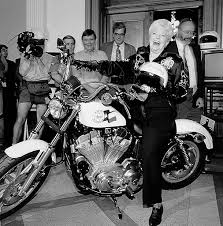
In her later years she travelled around the US campaigning for Democratic candidates and her popularity made her a cultural icon. Getting her motorcycle licence at age 70 helped. She also starred in a set of television advertisements.


She was a devastating debater and a captivating speaker. She brought down the house at the 1992 Democratic Convention when she delivered the nomination speech for Bill Clinton.

She was known for her oratorical skills and sense of humor. In a country where politicians can be dull and drab and bland, she stood out and then some. As small taste can be seen here.


Notable quotes can be found here but my personal favourites include:
  • I've always said that in politics, your enemies can't hurt you, but your friends will kill you.
  • If you give us the chance, we can perform. After all, Ginger Rogers did everything that Fred Astaire did. She just did it backwards and in high heels.
  • Poor George (President Bush Sr.), he can't help it. He was born with a silver foot in his mouth.
We won't see her like again too soon. Too bad.

Tuesday, September 12, 2006

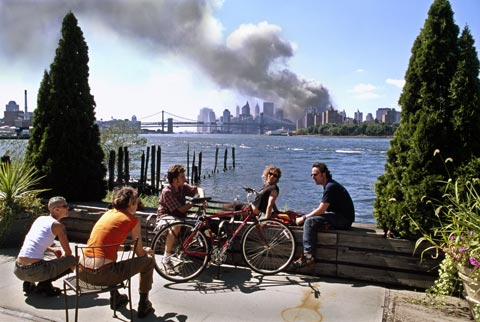
Distraction during destruction

I saw this photo on Slate.


The New York Times writer Frank Rich wrote:

Seen from the perspective of 9/11's fifth anniversary, Mr. Hoepker's photo is prescient as well as important—a snapshot of history soon to come. What he caught was this: Traumatic as the attack on America was, 9/11 would recede quickly for many. This is a country that likes to move on, and fast. The young people in Mr. Hoepker's photo aren't necessarily callous. They're just American. In the five years since the attacks, the ability of Americans to dust themselves off and keep going explains both what's gone right and what's gone wrong on our path to the divided and dispirited state the nation finds itself in today.

Andy: You Talk Too Much

Just when you thought that the city and province could enjoy some Andy-free media, our hopes have been dashed by his latest remarks.

Wells' attacks on Hearn guarantees that nobody in any position of responsibility will ever talk to or deal with Andy ever again.

When Wells accused Hearn of misleading him through empty assurances that the CEO and Chair job was his, he took one more step into political pariah status. And it doesn't matter if the charges are true or not.

If Hearn did make those remarks, then besides the fact that Heanr had no business making comitments in an area over which he had no control, then Andy has assured that nobody will ever provide him with any kinds ov committments, empty or otherwise.

If Hearn did not make those remarks, then Andy's bold-faced lies means nobody will touch him with a ten-foot pole.

Either way, Andy's telephone won't be ringing for a while and his calls won't get returned.

Not an auspicious beginning when embarking upon a new career as board member of the CNLOPB.

Senate Reform from the Reformer - Part 2

Prime Minister Harper'’s current proposal before the Senate which precipitated his appearance are contained in Bill S-4, An Act to amend the Constitution Act, 1867 (Senate tenure). It's short, sweet and to the point: senators appointed after this Bill comes into force will sit for a term of 8 years.* That's very clear and has been on the public record for months.

What's new is the announcement he made during his appearance: this Fall he intends to introduce legislation to allow for elected senators rather than the current practice of Prime Ministerial appointments.

Let's take these issues one at a time and see where they lead us. First, the term limits.

Senator Marjory LeBreton, the Government House Leader in the Senate, stated that:

"The proposal to set the length of tenure at eight years does not change the method of appointment, the powers of the Senate, or the distribution of seats, which are known as "essential characteristics of the Senate."

Altering essential characteristics requires the use of the more demanding amending formula contained in the Constitution Act, which requires the support of the provinces. It is clear that Bill S-4 can be enacted by Parliament alone, as was done in 1965 when life tenure for senators was changed to the present mandatory retirement at age 75.

Comprehensive change that will make the Senate an effective, independent and democratically elected body that equitably represents all regions will require the consent of at least seven provinces representing 50 per cent of the population because these moves would alter "essential characteristics" of the Senate. This will take more time.

Therefore, in proposing a Senate tenure of eight years, the government has taken a significant first step toward ensuring that this important democratic institution evolves in step with the expectations of Canadians. It is a step that stands on its own as laudable and reasonable."

It's interesting to note that she uses the precedent of the 1965 tenure change to justify making the current change. In fact it is not clear at all that these kinds of tenure changes can be made by parliament alone for two reasons.

The 1965 change was initiated by the Canadian Parliament but then it had to be sent to Westminster for ratification through an act of the British parliament; that's the way amendments were done back then. This differs from her contention that the Canadian parliament did it alone.

Secondly,this pre-dates the Constitution Act of 1982 which established, for the first time, a made-in-Canada amendment formula for things like this.

Bear with me for a minute: Section 42. (1)(b) says that amendments affecting "the powers of the Senate and the method of selecting Senators" may be done only in accordance with the amendment formula in 38(1).

And in 38(1) the formula is passage by the parliament (House of Commons and Senate) and 2/3's of the provinces with at least 50% of the population.

It's worth noting that there are several amending formulas specified in the constitution. The first is that one: the 2/3's-50% formula.

The second is in section 38(2) and says that if the amendment affects only one province then it need only be passed by the federal parliament and the affected province only. If you think that's arcane, remember that this province has used that section twice already; once to change the name of the province and anther time to eliminate the denominational school boards.

The third and last is section 44: Parliament exclusively may amend the constitution on it's own if, and only if, it's related to "the executive government of Canada or the Senate and House of Commons".

The Senatorial question of the day is this: Can Prime Minister Stephen Harper unilaterally change the tenure of senators from retirement at age 75 to an 8 year term without going to the provinces for approval?

And the answer is probably. It depends on if the tenure change comes under "the executive government of Canada or the Senate and House of Commons" but only the Supreme Court of Canada knows for sure and we won't know that unless there's a reference of the question to the court or unless the proposal passes and then somebody takes it to court.

I'm not sure who would care enough to go through that effort especially since it seems likely that senatorial tenure comes under the matter of executive government of Canada. So Harper can probably go right ahead and make the change he wants without any provincial consultation and avoid going cap-in-hand to the provinces.

Next post will plough through the issues around the elected Senate proposal. I promise that issue will be more interesting.

----------------------------------------------------
* It's silent on the matter of re-appointments so, in theory, a Prime Minister could hand somebody a re-appointment on their way out the door and steer them right back in again. But no matter; that's not relevant to this discussion.

Monday, September 11, 2006

Premier Williams Accepts Reality re Ruelokke

Back on August 8, I offered advice to Premier Williams on his best option to deal with the Ruelokke delimma based on my past experience in advising Premiers and ministers on getting out of the problems they put themselves in.

My advice would have been:

"Mr. Premier, it's time to cut your losses. Your misplaced determination to install Andy Wells as Chair has caused you and this government severe legal and political embarrassment. The public perceives that this has become an issue of stubbornness on your part and wants you to move forward.

As you previously promised, don't appeal this decision.

Instead immediately issue a press release appointing Mayor Wells to the vacant seat on the CNLOPB, and be sure to include all the usual accolades about how he will fight for the interests of all Newfoundlanders and Labradorians etc, etc, etc.

At the end include a paragraph accepting the judgement of Justice Halley and wishing Ruelokke well in his position as Chair and CEO of the CNLOPB.
Maybe more time passed than was seemly but in the end the right thing was done; no charge for the advice this time.

9/11

(Updated pics)

I'm not usually inclined to post about things like this but this one poked me in the gut harder than these things normally do.

From '85 to '87 I attended university in Rhode Island. My oldest brother, the news photographer, moved into New York about the same time. Not quite New York but Jersey City right across the river. You could step out of his apartment and see the twin towers. There were the great landmark for orienting oneself.

Pretty well every second weekend I'd hop the Amtrack train in Providence, RI and ride the 4 hours or so the Penn Station in Manhattan, catching up on my studies on the way. Then I'd transfer to the Jersey City train across the platform and make my way to my bro's apartment.

We'd play cribbage, talk, eat, smoke too much and spend many evenings and days in the city. Sometimes I'd go myself, other times with him and oter times I'd meet him there. The way into the city was always the same: PATH train from Jersey City station to the main transportation nexus under the twin towers and then catch whatever train or subway I'd need to take from there.

I knew those towers well.

Sometimes I'd go to the top for the hell of it. You simply couldn't beat the view. They had express elevators to the top that'd make your ears pop. The subway station below was filled with great stores and places to eat. My favourite was a BBQ place that served pulled pork sandwiches. I loved those sandwiches and I'd get one every chance I'd get.

A few weeks ago we saw the 9/11 movie WTC. The area where those firemen were trapped was a spot I walked through dozens of times.

The morning the towers were hit, my first thought was for my brother. As a news photographer, he has an instinctive response to big trouble: while others run away he's the one running into it. I knew that morning would be no different.

I tried to call him at his home on and off through the day. Around mid-afternoon I caught his wife at home. Her voice was tight and controlled in a way I'd never heard it before. She told me that he got the call from the New York Times as soon as the first plane hit and he fairly flew out of the house. No, she hadn't heard from him since. My other two brothers and my mother had already spoken to her tool. Yes, she would tell him to call me when she next spoke to him.

After school that afternoon, my boy, then 8 was watching TV. He'd watch the towers get hit by the planes and them collapse like a house of cards over and over again. He was fascinated as we all were. He asked if uncle Norman was in New York.

Yes, I said. He thought about that minute.

"Is uncle Norman dead", he asked. That was the question on my mind too.

"No", I said, "Don't worry about uncle Norman. He can take care of himself."

Very late that night the phone rang and it was Norman. He had gotten trapped on the Jersey side of the river when they closed all the bridges and tunnels into the city. Turned out he was on the edge of the river shooting the buildings and the crowd response from there, frustrated he couldn't get closer but making do the best way he knew how.

(copyright NY Lono 2001)

(copyright NY Lono 2001)
"Do me a favour," I asked him. "Call your nephew in the morning. He'll be glad to hear from you."

The world is a small one.

(copyright NY Lono 2001)

Sunday, September 10, 2006

Unfit to Govern, Unfit to Oppose

(update - see here too)

I become more convinced every day that the NDP are not a political party in the true sense when I see stories like this one on VOCM:

Michael Supports Withdrawal of Troops

Provincial NDP leader Lorraine Michael says she supports the federal party's call for a withdrawal of Canadian troops from Afghanistan. Michael is attending the federal NDP convention in Quebec City. She says the majority of the Newfoundland delegation also supports the withdrawal of troops. NDP delegates voted about 90 per cent in favour of leader Jack Layton's call for a pullout, making it formal NDP policy. Layton wants Canadian troops out of Afghanistan by February.
Instead they are a group of well-meaning, social-minded dilettantes with little, if any, interest or awareness in the substance or consequences of public policy decisions beyond their simplistic and surface standards of pseudo-morality.

The NDP, in their present state, are clearly unfit to govern this country or this province. They cannot even reach their own rather modest goal of presenting a principled opposition.

Friday, September 08, 2006

Bill Rowe - Zealous Guardian of the Orthodoxy

I don't have a problem with healthy debate and disagreement. In fact, it can be fairly said I live for it.

I've been a competitive debater, coach, judge and organizer for nigh on 25 years. I spent many happy times traveling throughout Canada, the USSR, Europe and up and down the US east coast visiting top universities where I verbally beat up on the very best the global debate circuit had to offer. Of course I received beatings in return; that's the way the game is played.

My debate style was described by some as "take no prisoners" and that is certainly the style I continue to coach and advocate to this day. You learn fast that you don't go for the low blow; that's an automatic loss and a petulant admission of defeat. Besides, if you are any good at all, it's just not necessary; there are just too many legitimate augments to make on any given issue.

So when I put a call into one of our fair province's talk radio shows, I look forward to crossing swords and exchanging positions and views with the host on the issues of the day.

I'm a big fan of Randy Simms, for example. He's smart, tough, fair, unerringly accurate, even-tempered, even-handed and unwaveringly courteous at all times; he's always game and he's never nasty. He's the best thing in talk radio today, in my opinion.

However, it's been long observed by many fans of the genre that the character of the afternoon show with Bill Rowe has become darker with a negative undertone. Callers are more likely there than on other shows to be cut off or their point of view casually and summarily dismissed. There is audible impatience with other points of view and there is a tendency to quickly resort to negative labeling rather than dealing with the issues.

Opposing points of view and callers themselves, are frequently labeled "stupid" or with other similar epithets.

But today, Mr. Rowe truly outdid himself.

I called this afternoon to comment on Premier Williams' reaction to Harper's letter on the offshore. In that letter Harper stated that Hebron was a commercial dispute and he would not get involved.

My points were threefold:

  1. Premier Williams should not have been surprised by this response since Harper himself said exactly the same thing months ago;
  2. Even if Prime Minister Harper did agree to initiate fallow-fields legislation, it would be unrealistic to expect him to make it retroactive and so this would have no effect on the Hebron negotiations anyway; and
  3. Provincial governments since Peckford have fought (legally, constitutionally, politically) to eject the federal government from offshore oil jurisdiction so that the province could manage the issue for itself: royalties, terms of negotiations and benefits. Therefore it is incongruous for this provincial government, to become disagreeable about the feds staying out of the very jurisdiction the province has worked so hard to eject them from.
One would think that these points might become the basis for an interesting and substantial discussion. And that's the way it would have gone with another host. Mr. Rowe's preferred response, however, was to sidestep the issues, attack me for being partisan and accusing me of selling out the province for my position.

It's not often I'm accused of selling out the province for simply offering a legitimate and responsible alternative point of view from his.

I'm not sure what provoked such a violent and unfair reaction. Perhaps he believes that questioning prevailing provincial government orthodoxy is tantamount to heresy. Maybe I just caught him on a bad day. Or it could be that he was annoyed that I specifically rebutted points made in his regular Saturday Telegram column with a letter of my own.

In any case he clearly needs to exhibit more professionalism in his broadcasting activities than he has shown today. It's sad to see a man of promise and ability reduced to defending the status quo with low-rent ad hominim attacks and intolerant dogmatic political cant.

Thursday, September 07, 2006

Senate Reform from the Reformer - Part 1

It was only a matter of time until Prime Minister Harper devoted some time to one of his favourite long-standing issues: Senate reform. Today in the first-ever appearance of a sitting Prime Minister before the Senate of Canada, Harper announced he would be introducing legislation in the Fall sitting of the House to elect senators.

He has already introduced legislation to change to change the term of senators from retirement at age 75 (brought down from a lifetime appointment in 1965) to a single 6 to 8 year term depending on how the Bill changes as it progresses through the House and Senate.

Those with a long memory will recall the bad olde days of the Reform Party under Preston Manning when the battle-cry was "the west wants in!" One of the ways the west wanted in was through the Triple-E Senate. The idea was relatively simple one albeit with complex ramifications. The goal is to reform the Senate such that it would become:

  • Effective: Because the Senate is not elected and appointed on a partisan basis, it lacks legitimacy and is unaccountable.
  • Equal: Rather than representing regions, each province would have an equal number of senators more like the US Senate.
  • Elected: The Senate and its important functions must be elected in order to play a legitimate role as a lawmaking body with the members accountable to the people of Canada through a democratic election process.Fundamentally, Senate reform is about three issues: powers, composition and membership.
In terms of powers, it is widely unrealized that in all powers except the ability to originate a money bill (budget, tax or expenditure) the Senate and the House of Commons are equivalent constitutionally.

In fact in the early days of Confederation, it was unclear where the power would eventually lay so John A. MacDonald seriously looked at a Senate seat because he thought that might be where the action was going to be. As it turned out the real action lay with the House of Commons but that has evolved that way because the Senate has largely declined to exercise the powers it has.

These days the Senate has taken on different roles - investigative, committee reports, legislative refinement - but has seldom thrown it's weight around because it has lacked the electoral legitimacy to do so with any confidence. The exceptions, like the GST Senate insurgency under Mulroney, are very much the exceptions.

Few, if any, Senate reformers have suggested trimming Senate powers (other than those advocating total abolishment) and many have suggested expanding the powers to be more like the US Senate (approving treaties, court appointments etc).

The composition of the Senate has been a ripe target for senate reformers. Right now the Senate has 105 members broken down into the 4 regions of West, Ontario, Quebec and Maritimes with 24 senators each plus further adjustments for NL and the territories. The final provincial tallies are:
  • Alberta 6
  • British Columbia 6
  • Manitoba 6
  • Saskatchewan 6
  • New Brunswick 10
  • Newfoundland and Labrador 6
  • Nova Scotia 10
  • Prince Edward Island 4
  • Ontario 24
  • Quebec 24
  • Yukon 1
  • Northwest Territories 1
  • Nunavut 1
An article of faith amongst the triple-E advocates is that this arrangement is manifestly unfair and they want to see, at a minimum, equality among all provinces. Manning backed the idea of 10 senators per province. The argument is that there needs to be some regional balance in the central government to protect the less populous regions of the country from central domination.

The next post will discuss the implications of Harper's proposal for an elected Senate and what he needs to do to achieve it.

Thursday, August 31, 2006

Undersea Ancient Wonders

Follow this link to an amazing gallery of photos of recent discoveries at the site of ancient Alexandria.

You won't be disappointed.

Wednesday, August 30, 2006

Williams, Ruelokke, Halley and a cup of joe

This is a letter from me to the editor published today in the Telegram.
------------------------------------------------------------------------------

I feel compelled to respond to the Saturday column by Bill Rowe on the issues surrounding Premier Williams and the Max Ruelokke decision penned by Justice Halley.

Mr. Rowe divides the issues into two separate matters. The first is the substance of the decision, where Justice Halley concludes that Max Ruelokke now holds the job of CEO and Chair of the CNLOPB. Mr. Rowe made it clear that he has no problem with those conclusions.

However, he does take issue with the knuckle-rapping Premier Williams has received over his public criticisms of the Halley decision. Williams, to several media outlets over several days, repeatedly characterized the decision as “over the top” and remarked that Justice Halley must have “gotten up on the wrong side of the bed”.

The rapping has come from the president of the Canadian Bar Association, J. Parker McCarthy, QC, the opposition justice critic, Kelvin Parsons, and a Halifax-based constitutional scholar, among others.

Rowe’s defense of the Premier boils down to a simple idea: an elected Premier has the right to publicly criticize a judge’s ruling on a matter of public interest.

Fair enough. But when does the premier plan to do that? How do any of his remarks so far constitute in any way fair criticism of the judge’s ruling?

In fact, the Premier’s remarks have had nothing to do with the substance of the judge’s reasoning or conclusions. Instead he has focused exclusively on undermining the credibility of the judge and belittling his ruling by calling into question the manner by which Halley came to his decision.

After all, the Premier seems to say, how can you take a ruling seriously that’s a product of mere Monday morning crabbiness? Would the ruling would have been different if Halley had downed a second cup of joe?

I agree that the Premier has a right to fair and responsible criticism. However, fair and responsible criticism does not include repeatedly going for the cheap shot in every media outlet available. Surely when his communications staff comes up with these kinds of lines-of-the-day, the Premier should have the judgment to reject them as inappropriate to his office.

Rowe went on to ridicule the idea that the Premier somehow owes greater duty to the Law Society than to the people at large. And rightly he should ridicule that contention. However, I have heard nobody besides Rowe make it.

Instead he should consider is that the Premier has a greater obligation than other people to support the integrity of the legal and judicial system of the province. As Premier, he sits atop a system of administration and governance which is founded on the rule of law and not on personal whim and caprice. When that foundation of law is undermined, all that is built upon it is undermined.

If the Premier wants to make fair and responsible criticism of a legal decision on an important issue of public policy, I say go for it. However, nothing he’s said so far fits into that category.

Too bad, because I believe he’d be capable of it if he really tried.

Friday, August 18, 2006

Thank you Telegram

About a year ago I replied to the Telegram's call for members of their Community Editorial Board. I submitted a few pieces and, to my surprise, I was accepted!

Since then they have published 6 of my pieces on their editorial page. The topics have ranged from municipal election reform to global warming to the Ruelokke-Williams-CNLOBP dispute.

I just wanted to thank the good people at the Telegram for the opportunity to participate in their community editorial board with a special thanks to Joe Walsh for his enormous patience. He would sometimes call me while I was in Iqaluit or Montreal or wherever I'd be stuck working at the time to remind me a piece was due. He always took me at my word when I told him that, by good or by God, I'd get it to him. I always did but sometimes it was a near thing.

One time I took shots at the anti-sealing industry that hit too close to home for their liking. As per their latest strategy of silencing their critics through the liberal application of libel chill, the anti-sealing legal dweebs formally complained to the Tely and forced a pro-forma apology out of them. They did the right thing, I thought, because it was never my intent to ever cause the publication any trouble. They issued the required correction because their lawyers told them to but I could hear the teeth gritting from here.

And the good people at the Tely never held that against me and for that I am grateful.

Yesterday was the last piece to be published. That one, and the other, are gradually being added to this site as I get around to it.

Thank you, Telegram, and keep up the good work!

Thursday, August 10, 2006

"I will abide by Halley's decision. . . Eventually"

Kathy Dunderdale, spokesperson for Premier Williams in the Department of Natural Resources, was quoted in the CBC radio news this morning on the issue of Max Ruelokke and the ongoing controversy of the CNLPOB Chairmanship. She was directed to say that:

"We're not going to comment on the Max Ruelokke decision at this time . . .We have received the judgment, the Department of Justice is reviewing that for us and until that review is complete, I won't be making any comment."

For fans of judicial decisions, Judge Halley's stands apart in its decisiveness, clarity and straighforwardness; that will make the review fairly easy. No doubt the capable counsel at Justice will spend most of a cofeebreak coming to their conclusions.

Looking for a Hole

On July 12th, Premier Williams, in a scrum outside the House of Assembly on the topic of Justice Halley's remarks during closing arguments was also decisive, clear and straightforward: he would abide by the decision of the Supreme Court of Newfoundland.

So why the delay now?

If pressed, if one could get a government official to respond, I suspect that the answer provided would be all about government being prudent, doing drilldown, performing a due diligence piece and all the other buzzwords that get bandied about to provide cover for what is simply playing for time until government figures out which way to jump.

In other words, the Premier now regrets those hasty words in the scrum and is seeking a way out of his box. So what will he do now? This previous post covers some of the options available to him but which will he choose?

We can't be sure until that's announced but we can extrapolate what he should do based on his popular image and preferred self-descriptions: as the eminent lawyer, successful businessman and honourable politician.

As a lawyer he can read and interpret the decision and understand that Ruelloke is already the de facto chair. As an officer of the court, he is obliged to heed decisions of the court without undue or mischievous delay. If he plans to appeal, he should be announcing that without delay.

As a businessman he must be aware of the hazards of instability in the province's largest industry; the single biggest own-source of government revenue and the largest industrial component of the GDP. He understands that the longer this issue drags out, the more he shows the world that the regulatory regime of the province and economic policy of the province is based on personal capricious whim and not the rule of law.

As an honourable politician he is obligated to stand by his word and his word was that he would abide by the decision of the courts. At that point he placed no caveats, equivocations, conditions or exceptions to his declaration of intent to abide by whatever decision came out.

This is a watershed moment for this government and for the Premier in particular; unjustified delay under the camouflage of prudence damages credibility and calls into question any statement made in the future on any issue.

Get on with it.

Wednesday, August 09, 2006

OffalNews now CBC affiliate

If you look down the right column you will see the latest breaking news headlines direct from CBC. That's because OffalNews is now proud to be an official CBC affiliate.

That does not mean I have to pay them or they have to pay me or you will have to pay anybody or will receive payment from anybody. And it's not any kind of mutual endorsement of quality or content (although I do like them a whole lot).

Consider it a convenient service from the friendly people here at OffalNews - The Guts of Public Affairs, Economics and Politics.

Government and Ruelokke: Time is ticking

As Ed has mentioned, it's been 48 hours and still no response from government on the Ruelokke v. Government of Newfoundland and Labrador decision.

Maybe government thinks it can take its time in thoroughly reviewing the matter at its leisure. If so then government would be wrong. Time is ticking and other forces are moving forward.

In the judgment of Justice Halley, paragraph 59 says:

"It is now time for the Respondent to accept the Panel'’s decision and permit the Applicant to get on with the job of running the Offshore Petroleum Board."
So what choices are open to government? I think they are pretty clear. Government can:

1) Immediately heed the judgment and let Mr. Ruelokke take the job he has already held de facto since December 5, 2005. This would put the matter to bed, government can redeem itself and could move forward with it's agenda.

2)
File an appeal. This is most likely a fruitless exercise and just delays the inevitable. It also has the side-effect of making the government and the Premier look more spiteful and obstinate than they look already.

3) Buy off Ruelokke. To the government an attractive possiblilty except that he has thus shown absolutely no interest in stepping aside in any way shape or form. Thanks to the clarity of the Halley judgment, I can only imagine he'd be less inclined now.

4) Refuse to heed the decision. This puts government in the position of refusing to comply with both the federal and provincial legislation - the Atlantic Accord enabling acts - that outlines the division of powers and responsibilities in the management of this resource. This option has the side bonus of provoking an unprecendented fundamental constitutional crisis on the issue of government versus the powers of the judiciary and, as an officer of the court, puts the Premier in a personal conflict.

5) Try to bring the federal government onside and sidestep this entire mess somehow. Unfortunately, the federal government has hitherto shown no enthusiasm for the provincial position and, by contrast has been very supportive of the process generally and the candidacy of Max Ruelokke in particular. Even if the feds were inclined to agree with the province, it's a process that could take months or years, cost the feds much credibilityy in the industry and the larger business commmunity with no advantage to itself. And there would still be the issue of compensating Mr. Ruelokke.

6) Just delay delay delay as if the province had all the time in the world and hope it will all go away.

While government is dithering, Mr. Ruelokke has shown every disinclination to stand by and leave his fate in the hands of others. He is quoted as saying that he hopes to be on the job by Labour day. I have no doubt that he will take further action then if the government continues to do nothing.

That leaves Premier Williams just 3 weeks to make the next move.

In the meantime, the federal government will likely publish their own Order in Council confirming Mr. Ruelokke in the job.

Tuesday, August 08, 2006

Just why Andy anyways?

Almost a year ago Andy Wells leaked to the media that he was Premier Williams' choice for the Chairmanship of the Canada-Newfoundland and Labrador Offshore Petroleum Board.

The reaction was immediate. There was the obligatory and pro forma announcements of support from the friends, family and supporters of both Wells and Williams. Specific interest groups were horrified: a chill went through the local oil and oil-related community. Generally, though, the people of the province scratched it's collective head trying to figure out what was going on. We still are.

But some things have become clearer in the last 12 months. The first thing that comes to mind is that Wells now has the same chance of becoming Chair of the CNLOPB as my cat. The second is that Premier Williams will steamroll over anybody (Max Reulokke), hang up the legitimate activities of any organization (the CNLOPB) and stop any industry in its tracks (oil development) to get what he wants.

The real question is What does Premier Williams really want and why does he want it?

There was some speculation that Williams didn't really want Wells as Chair and wildly different reasons were proposed. Some thought he just wanted him out of the Mayor's chair to facilitate regional municipal amalgamation or to pave the way for his old buddy Jack Harris to waltz into city hall. Others thought that Wells was a bogeyman candidate in order to get another, more realistic and acceptable candidate in place.

I don't think we will ever know for sure why such a patently poor candidate was put forward by the Premier. Wells may question Halley's characterization of him as an unqualified candidate but let's call a spade a spade: Wells is a professional municipal politician with no experience in any business sector touching on the petroleum industry and has no technical expertise or training in any of the issues that the CNLOPB deals with every day.

There are some politicians who believe that their political experience provides some kind of universal qualification for every and any field of human endeavor. Wells is clearly one of those and Wells is clearly wrong about that - political experience does not provide anything like those qualifications. It can provide leadership experience in bringing together disparate groups and welding them into a consensus in order to achieve a higher goal. It would take an over-dose of hallucinogenics for a sane person to put Wells into that category of politician.

So why did Williams propose him? I think it can only fall into that class of things that seemed like a good idea at the time.

Williams' public reasons have been clear enough. Generally he wants the CNLOPB to stand up for the interests of people of the province and more specifically he wants the CNLOPB to initiate a fallow-fields process and so push the Hebron consortium into a deal of Williams' making.

Unfortunately for us who are trying to figure out what is really going on these public reasons are total nonsense. First the CNLOPB is a regulatory body that does not negotiate or establish industrial benefits for the province. Rather, it manages benefits that are previously negotiated and approved by the provincial government and industry consortium. In other words, it can only play with the hand that is dealt to it by others.

This puts the industrial benefits issue back into Williams' lap.

Second, and possibly more important, the CNLOPB cannot and will not initiate a fallow-fields process to push Exxon-Mobil et al off the Hebron project. The only way that could happen is to get the federal government to commit to supporting the province on the grounds of national self-sufficiency or national security of supply.

Not only do neither of these grounds apply to this case (Williams being merely unable to get what he wants), Prime Minister Harper has already made it abundantly clear that he views this dispute as a purely commercial one, to be resolved through negotiation. Notwithstanding the Premier's hopeful comments, no support will come from that source.

So again, the matter is thrown back into Williams' lap.

Does Williams really understand the environment and institutions he's dealing with? Can he be so fundamentally mistaken in such matters of basic roles, principles and responsibilities? I can't imagine how his experience as a lawyer and businessman, his exemplary education or the experience and knowledge of the senior officials who advise him could possibly lead him this far astray.

Far be it from me to question the motives driving the most popular provincial premier since Smallwood, but it seems clear that he will not be able to get through cheap and easy back doors what he has been so far been unable to achieve through the challenging and time-consuming front door. Governing a province is less about the grand gesture timed for the latest quarterly poll and more about the slow and incremental process of dealing with the dirty details like swallowing your pride and constructively bringing people together in negotiations to the benefit of all.

It's not always a zero-sum game, where winning necessitates others losing. Sometimes all sides can win.

Lets get on with it.

Williams vs Reullocke - Plan B

Not since the Peckford/Trudeau oil wars in the 80s has the province been so severely rebuked by the courts on a matter of public policy close to the Premier's heart. At that time Peckford went all the way to the Supreme Court of Canada, insisting every step of the way that the province had jurisdiction over the offshore. And at every legal step of the way, the province was told that it had no such jurisdiction ever in the past, present or future.

Peckford's response was to call for a provincial day of mourning, complete with black armbands - and then he got on with the work of the province, culminating in the successful negotiation of the Atlantic Accord.

Those judgments, as definitive as they were for their time, were couched in language only a constitutional lawyer (and constitutional geeks like me) could love.

That puts the Halley judgment on the CNLOPB/Max Ruelokke case in a class by itself. In the end, Halley held that:

"Max Ruelokke has been the de facto Chair and CEO of the Board since the tribunal made its selection on December 5, 2005 and the Respondent is bound by the Panel's decision. The conduct of the Respondent was 'reprehensible', therefore it shall pay the Applicant his solicitor-client costs."
Bad enough that the government's actions are described as reprehensible, but then Halley goes on to itemize eight distinct reasons why the province has acted in a manner he deems reprehensible. These were:
  1. The Respondent (government) had an opportunity to argue for the 'splitting' of the positions of Chair and CEO of the Board before the Panel was constituted but failed to do so.
  2. Upon receipt of the decision of the Panel the Respondent immediately took the position that it was not bound by the decision.
  3. The Respondent was aware that the issue of 'splitting' the positions of Chair and CEO of the Board was outside the mandate of the Panel, yet it seized on that non-binding advice as a reason for rejecting the Panel's selection of the Applicant.
  4. Prior to the commencement of this litigation, the Respondent refused to give the Applicant a rational explanation for its refusal to recognize him as the Chair and CEO of the Board.
  5. As a result of the conduct of the Respondent, the Applicant has been unemployed since March 24, 2006 and cannot obtain other employment in the petroleum industry because of the possibility of 'conflict of interest'.
  6. It may have been a mistake for the Respondent to promote an unqualified candidate for the position of Chair and CEO of the Board prior to the Panel's selection of the Applicant, but it was mischievous for the Respondent to continue to 'push' for his appointment after the Panel had made its decision.
  7. In this case, the Respondent's actions were meant 'to defer, delay and deflect' the selection decision of the Panel.
  8. On the whole, the Respondent has treated the Applicant with contempt and disrespect.
One thing about Peckford's wars was that his fights avoided producing roadkill out of innocent bystanders. This particular war maligned the motives and professional integrity of Max Ruelokke through the Premier's public musing about his being in the pockets of the oil producers and suggesting that Mr. Ruelokke would therefore represent their interests over those of the people of the province.

And just when you thought things were as bad as they could get, Halley cheerfully noted that:
"The federal government took the position that it wanted the Panel to choose 'the most capable candidate'. However, the Respondent chose to support one person and urged the Panel to select its candidate who was a long-term local politician. The Respondent's campaign to promote its candidate was 'doomed to failure' because he had neither the professional background nor the industry experience to be qualified to act as the Chair and CEO of the Board."
For that unnamed unqualified candidate read Mayor Andrew Wells, the Premier's favorite for the job.

Now Williams has placed himself on the horns of a dilemma: he can either accept Ruelokke as Chair (thus tacitly accepting and admitting the harsh rebukes launched at him and his government by Justice Halley) or he can continue the fight with ultimately unsuccessful appeals to higher courts (thus delaying the issue even further and taking criticism in the process for being driven by ego rather than sound public policy).

So far thegovernment response has been an eerie silence, notwithstanding a cursory "we are studying the judgment" statement and reports of journalists being bounced back and forth between the office of the Premier and the Natural Resources minister.

So what choice of action does Williams have now? Here's my suggestion to him and this is how I would advise him if I worked up there:
"Mr. Premier, it's time to cut your losses. Your misplaced determination to install Andy Wells as Chair has caused you and this government severe legal and political embarrassment. The public perceives that this has become an issue of stubbornness on your part and wants you to move forward.

As you previously promised, don't appeal this decision.

Instead immediately issue a press release appointing Mayor Wells to the vacant seat on the CNLOPB, and be sure to include all the usual accolades about how he will fight for the interests of all Newfoundlanders and Labradorians etc, etc, etc.

At the end include a paragraph accepting the judgement of Justice Halley and wishing Ruelokke well in his position as Chair and CEO of the CNLOPB.
Then I would run away as fast as I could to avoid personal harm in the explosion of temper that would inevitably follow.

Sunday, August 06, 2006

Global Oil - Local Issue

Reproduced below is a piece from The Economist (if you don't already subscribe, what are you waiting for?) that's worthwhile reading. It's a brief profile of the head of ENI, a major oil company out of Italy and provides a very interesting perspective on the global oil industry and their relationship with nationalistic governments (of which Premier Williams would have to be counted as one for this discussion).

No doubt some will take this as a ray of hope for Williams' quest on forcing a Hebron deal on his terms.

Of course one significant difference is that this province doesn't actually own the resource. Under current federal-provincial arrangements, the province can stop deals, the province can allow deals but the province can't force deals. Nor can the province push a company off a license it alread holds. Recently the province has gone to the feds to get exactly those pwers.

Notwithstanding the "support" from the other Premiers announced at the recent Council of the Federation meeting, Prime Minster Harper has already made it clear that Williams should not be holding his breath.

-------------------------------------------------------

Jul 20th 2006, From The Economist print edition

Paolo Scaroni, an Italian oilman, believes big oil companies ought to be more humble

BIG Western oil firms are like addicts in denial, says Paolo Scaroni—and he should know, because he is the boss of the sixth-biggest, the Italian oil group ENI. The oil giants are trying to do business as usual, he explains, as if nothing is wrong. Yet they are, in fact, having trouble laying their hands on their own basic product. State-owned or state-controlled national oil companies (NOCs) are sitting on as much as 90% of the world's oil and gas, and are restricting outsiders' access to it. Worse, the best NOCs are beginning to expand beyond their own frontiers and to compete with the oil majors for control over the remaining 10% of resources. The first step in overcoming this predicament, Mr Scaroni declares, is admitting that it is a problem.

Not all oil bosses do. Rex Tillerson, the head of Exxon Mobil, the biggest private oil firm, insists that his company is not short of opportunities. David O'Reilly, who runs Chevron, another oil major, points out that despite a recent spurt of nationalism in Russia and Latin America, more of the world is open to firms like his nowadays than 20 years ago. With the price of oil high and with big oil firms chalking up record profits as a result, the oil and gas business hardly looks like an industry in crisis.

Most oilmen see the long-running battle between nationalist governments and foreign oil firms over the division of oil's spoils as the natural state of the industry. When the price is low, and money scarce, foreigners are welcomed for their access to capital and their ability to eke more oil out of the ground. When the price is high, and money abundant, their skills seem less useful and their fees more extortionate. But Mr Scaroni thinks that the battle is now over, and that the oil-rich countries have won. These days, he says, NOCs are capable of developing big, readily accessible fields by themselves—with a little technological help from service companies such as Halliburton or Schlumberger where needed. Even in countries where foreign oil firms still have a part to play, since the oil is hard to get at or the NOC inept, they are seen as supplicants rather than saviours, vying for the honour of extracting local resources.

So the majors must come up with innovative ways to make themselves useful. ENI is doing just that in Congo-Brazzaville, where it has developed several offshore fields that contain a lot of oil and a little natural gas. Other firms working in the country used to extract the oil from their fields and simply burn off the gas, since there was not enough of it to justify building expensive export facilities. But ENI decided to use its gas to fuel a power plant so as to reduce Congo's frequent power cuts. Better yet, it took the country's leaders to Italy to see similar plants of its own, to prove that it knew what it was doing. Most of ENI's rivals, Mr Scaroni says, could not have done the same, since they do not run gas-fired power plants. More to the point, they are not sufficiently imaginative about endearing themselves to the governments on whose sufferance they operate.

ENI is also deep in negotiations with Gazprom, Russia's state-controlled natural-gas monopolist. For ENI to get hold of more gas to feed into its European distribution network, Mr Scaroni says, it will have to gratify Gazprom's desire to gain direct “downstream” access to customers in Italy. The deal has yet to be done—but it is clear that ENI will be offering more than the majors' normal enticements of money and expertise.

These tactics are not as new as Mr Scaroni suggests. The Italian government founded ENI after the second world war to break the oligopoly of the “Seven Sisters”—the majors of the day and the precursors of Exxon, Chevron, BP and Royal Dutch Shell. From its inception, it presented itself as a more reasonable, flexible partner than the overweening Anglo-Saxon oil firms. In its first big foreign venture, it offered Iran three-quarters of the revenue from any production there, rather than the standard half. ENI's boss at the time reportedly even floated the idea of marrying an Italian princess off to the shah to seal the deal.

Nor is ENI the only energy firm trying to ingratiate itself with oil-soaked governments and their NOCs. Wintershall, a German oil producer, and e.ON, a German utility, recently swapped shares in various downstream businesses for a stake in one of Gazprom's big gas fields. Both are also co-operating with Gazprom on a new undersea gas pipeline to western Europe, to the consternation of east European governments. Similarly, many observers contend that BP subscribed to the recent public offering of Rosneft, another Russian NOC, only because it hoped to win better treatment for its Russian ventures.

Oil and water

But Mr Scaroni takes this deference further than most. He is not at all offended, he says, by the notion that governments will increase taxes or tear up contracts to try to grab a bigger share of the proceeds of oil production when the price rises. The oil belongs to the countries concerned, he says, not to the oil firms that pump it, which must accept that they have no God-given right to the extra revenue. He does caution that governments should change existing arrangements by negotiation, not fiat. Indeed, he is in the middle of a row with the Venezuelan authorities about just that. But it is a far cry from oil bosses' usual rhetoric about the sanctity of contracts.

Then again, Mr Scaroni is a far cry from the usual oil boss. He has been in the business only a year. Instead of serving a long apprenticeship within his firm, as did his counterparts at Shell, Chevron, Exxon and BP, he moved to ENI from Enel, Italy's biggest utility, which he ran for three years after moving from Pilkington, a British glassmaker. He studied economics and management, rather than engineering. His relaxed, self-confident demeanour stands in marked contrast to the gruff, awkward bearing of many oilmen. A fitting messenger, then, for the idea that big Western oil firms need to change their ways.